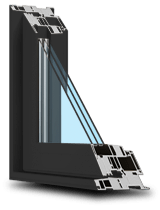
Modern front door designs: sleek, strong, and secure
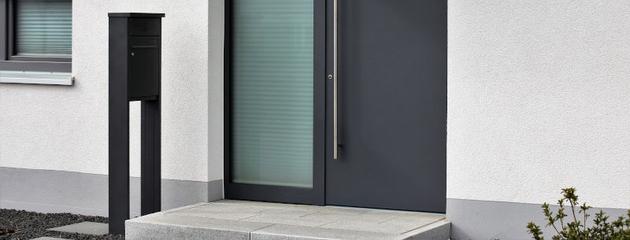

A front door is the first thing a guest notices and the last thing you touch when leaving home. In modern home design, it has shifted from a purely functional element to a key piece of the exterior, a place where the homeowner's design choices are most visible from the street, and where security, energy efficiency, and curb appeal all meet.
This guide walks through what makes a front door "modern" in 2026; the materials and design elements that define current trends; the colours and hardware homeowners are choosing across Canada; and how to consider energy efficiency, security, and smart-home integration when planning a new entry door.
Key takeaways
- Modern front doors favour clean lines, minimalist hardware, larger glass panels, and bold colour over ornate traditional detailing.
- Steel is the dominant material for modern Canadian front doors — strong, well-insulated, secure, and engineered for freeze-thaw climates.
- Top 2026 colour trends include matte black, navy blue, deep red, sage green, charcoal grey, and warm wood-grain finishes.
- Security in a modern door comes from multi-point locking, reinforced strike plates, impact-resistant glass, and quality installation — not just the hardware brand.
- Smart locks, keypad entry, and home-automation integration are increasingly expected in new builds and major renovations.
- CCW manufactures steel entry doors in four collections — Shaker, Design, Prestige, and Classic built in Canada and backed by a 25-year transferable warranty.
Traditional vs. modern front doors: what changed
The shift from traditional to modern front door design isn't just about aesthetics; it reflects a broader change in how homes are built and how homeowners use the entry. Traditional doors emphasized symmetry, ornate detailing, raised panels, decorative bevelled glass, and warm wood finishes. They were designed to feel substantial and crafted.
Modern doors take a different approach. The design language is reductive, with clean lines, fewer decorative details, larger uninterrupted surfaces, and a deliberate use of negative space. Where a traditional door might use carved millwork to draw the eye, a modern door uses a single bold colour, a strip of frosted glass, or an oversized pull. The materials shifted too: heavy solid wood gave way to engineered steel doors with insulated cores, designed specifically for Canadian climate performance.
Both styles still have a place in Canadian homes. Heritage neighbourhoods, character homes, and traditional architecture continue to favour the older style. Newer builds, infill projects, and renovated homes in dense urban markets increasingly choose modern designs.
What defines a modern front door

If you walk down a street of newer Canadian homes in Toronto's North York, Vaughan, Mississauga, or the newer suburbs of Calgary and Vancouver, the modern front doors share a recognizable design language. The common elements:
Minimalist design
- Flush panel construction — flat, single-plane door faces rather than raised mouldings or carved details.
- Clean, straight lines with no ornate trim.
- Use of negative space — large unbroken surfaces rather than busy patterns.
- Hidden or low-profile hinges that don't visually interrupt the door face.
Larger glass surfaces
- Full-light doors with floor-to-ceiling glass panels.
- ¾-lite designs with a continuous glass strip down most of the door.
- Horizontal lite arrangements — 3-lite or 5-lite glass inserts running across the door's width.
- Frosted or textured glass for privacy without sacrificing daylight.
- Sidelites and transoms are used as architectural extensions, not just decorative add-ons.
Bold, considered colour
- Matte black for sharp modern silhouettes.
- Deep, saturated colours — navy, forest green, deep red — that read confidently from the street.
- Warm wood-grain finishes on steel doors giving the modern panel construction a natural appearance.
- Dual-tone treatment, with one colour facing outward and another inward.
Geometric simplicity
- Rectangular and linear shapes dominate.
- Asymmetric layouts — glass panels offset to one side rather than centred.
- Grid-pattern glass arrangements as a design feature.
- Circular or oval windows are used sparingly, often as a focal accent.
Considered hardware
- Oversized vertical pulls in place of traditional knobs.
- Minimalist lever handles.
- Smart locks with clean keypad faces.
- Matte black, brushed steel, or satin nickel finishes — mixed sparingly with the door colour.
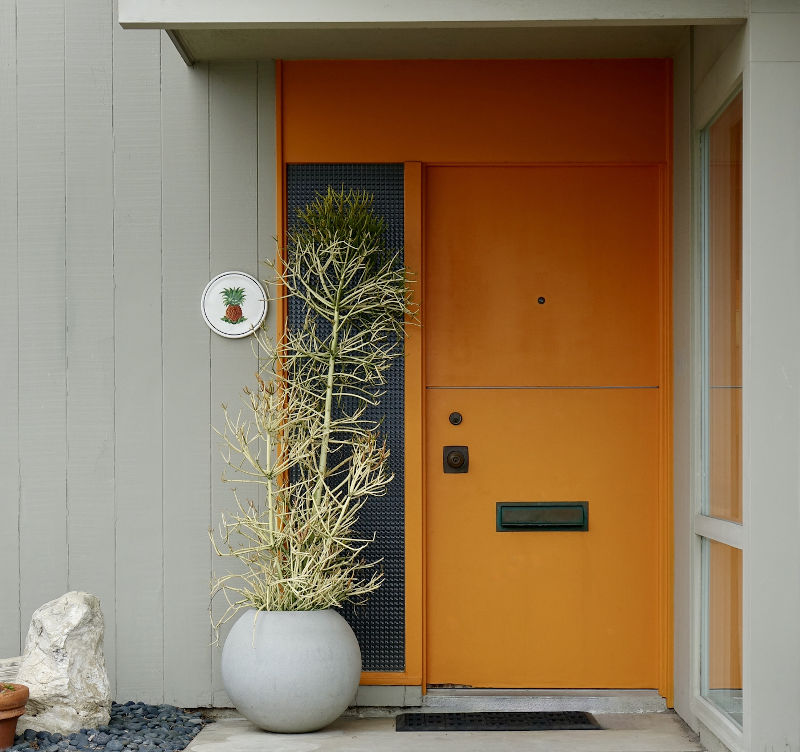
Material: Why modern front doors are usually steel
Three materials make up most of the residential front door market in Canada: steel, fibreglass, and wood. Each has strengths, and the modern aesthetic can be built in any of them, but the practical choice for most Canadian homes is steel.
Steel entry doors
A modern steel entry door is built with two steel skins around a polyurethane foam-insulated core. The steel skins provide structural strength and security; the foam core handles thermal performance. A thermal break inside the frame prevents heat transfer through the metal, which is critical in Canadian winters.
- Strength and security: steel resists kick-ins, denting, and forced entry better than other materials.
- Energy efficiency: insulated steel doors with thermal breaks deliver some of the strongest R-values available in residential entry doors.
- Climate durability: steel doesn't warp, crack, or rot through Canadian freeze-thaw cycles.
- Low maintenance: factory finishes hold paint well, and modern coatings resist chipping and fading.
- Cost: typically the most affordable of the three materials, which makes it the practical baseline for most Canadian homes.
CCW manufactures steel entry doors only. The decision is deliberate: across more than 40 years of installing entry doors in Canadian homes, steel has consistently delivered the best balance of security, thermal performance, durability, and value for Canadian climates.
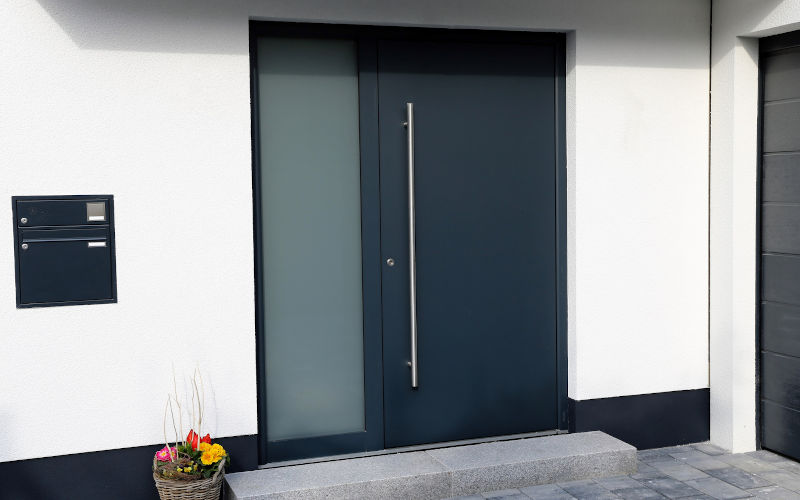
Fibreglass and wood, briefly
Fibreglass entry doors are widely available across Canada through specialized suppliers. They mimic wood grain convincingly, resist warping and rotting, and perform well thermally. They're not part of CCW's product line; homeowners who specifically want fibreglass can find it from other Canadian manufacturers.
Wood entry doors remain the choice for heritage homes, high-end custom builds, and homeowners who want a natural wood appearance and are willing to handle the maintenance, staining, sealing, and refinishing every few years. Wood is sensitive to moisture and Canadian temperature swings, which is why it's increasingly rare in modern new builds.
“The question we get most often is whether steel feels too utilitarian for a modern entry. The honest answer is that what's on the outside of a steel door is whatever the homeowner wants — flat paint, wood-grain finish, glass, custom hardware. The steel is what the door is built around, not what the visitor sees. People see the colour, the glass, the handle. The steel does the work behind that.”
— Helen Sin, Consumer Success Manager, Canadian Choice Windows & Doors
Design elements in modern front doors
Flush panel construction
A flush panel door has a flat, single-plane face without raised mouldings or carved details. It's the most common modern door construction and works well with bold colour, oversized glass, and minimalist hardware. The flat surface lets the door's other elements, colour, hardware, and glass carry the design rather than competing with raised panels.
Geometric glass arrangements
Where traditional doors used to bevelled or leaded glass with floral or curved motifs, modern doors favour geometric arrangements:
- Horizontal lites — 3-lite, 5-lite, or full-width glass strips running across the door.
- Vertical lites — narrow, tall glass panels integrated into the door face.
- Single full-light or ¾-light panels with frosted or textured glass for privacy.
- Geometric inserts — squares, rectangles, grid patterns, rather than curved or floral designs.
Oversized doors
Modern architecture increasingly uses extra-wide and extra-tall entry doors as a design statement. Standard residential doors are 32–36 inches wide; oversized modern doors can be 42 inches or more, and in some custom homes, doors extend from floor to ceiling. The dramatic scale changes how the entry reads from the street and how it feels to walk through.
Pivot doors
Pivot doors hinge on a central vertical axis rather than the side. The visual effect is significantly different from a standard door; the entire door rotates around its centre point, giving the entry a contemporary, architectural feel. Pivot doors are typically heavier (the hardware needs to support a center pivot rather than perimeter hinges), more expensive, and require more careful planning of the rough opening. They work best in larger modern homes with high ceilings and matching architectural intent.
Double-door configurations
Modern double doors, two doors hinged on opposite sides, meeting in the middle, work well for wider openings. Both doors can match in colour and hardware, or one can be a fixed decorative panel with only one operable side. Double doors create a generous entry experience but require enough wall width to accommodate them.
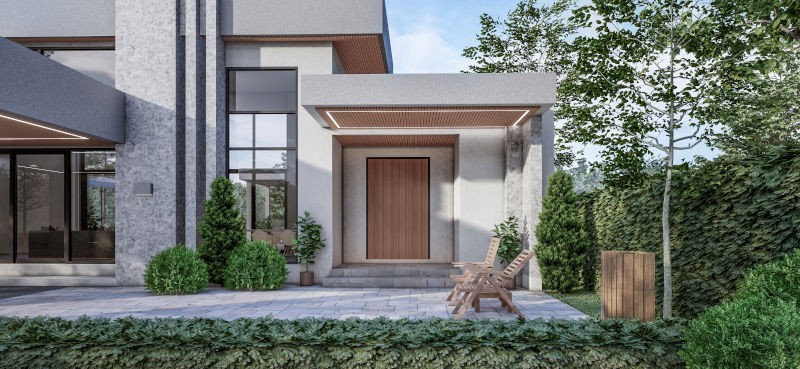
Modern front door colour trends in 2026
Colour has shifted significantly in the past few years. Where bright accent colours once defined statement entries (cherry red, sunshine yellow), 2026 has settled into deeper, more grounded choices that read confidently against modern exteriors.
| Colour | Best for | Why it works |
|---|---|---|
| Matte black | Modern, minimalist exteriors | Sharp silhouette against light siding or brick. Pairs cleanly with brushed-steel or matte-black hardware. |
| Navy blue | Modern and transitional homes | Confident without being aggressive. Reads as deliberate rather than trendy. |
| Deep red | Heritage and modern homes alike | A traditional choice with a modern feel, achieved through saturation and a matte finish. |
| Sage green | Biophilic / earth-tone exteriors | The fastest-rising colour trend. Calming, natural, and unusual without being odd. |
| Charcoal grey | Modern homes with cool palettes | Softer than black, with broader compatibility across siding colours. |
| Warm wood-grain | Modern homes want warmth | Wood-look finishes on steel doors — natural appearance without the wood maintenance. |
Dual-tone doors
One colour facing outside, another facing inside. Let the front door coordinate with the home's exterior palette while matching the interior decor independently. Becoming common on custom orders for modern homes.
Hardware for modern front doors
Door hardware does as much design work as the door panel itself. The right combination quietly signals the home's overall style; the wrong combination undermines an otherwise well-chosen door.
Hardware trends in modern doors
- Oversized vertical pulls: bar-style handles 18 to 36 inches tall replace traditional knobs and lever sets. Architectural rather than decorative.
- Minimalist lever handles: low-profile, geometric lever sets in brushed steel, matte black, or satin nickel.
- Smart locks: keypad entry with clean, flat faces. Brands like Yale Assure, Schlage Encode, and August are widely available in finishes that suit modern aesthetics.
- Concealed hinges: the hinges sit fully within the frame and door, invisible from the outside. Used in higher-end modern installations.
- Mixed metals: brushed steel paired with matte black, satin nickel paired with bronze. Once a faux pas, now considered common in modern hardware combinations.
Practical considerations
- Hardware needs to match the door's weight and security requirements. Oversized pulls aren't always paired with a strong latching system; confirm the multi-point lock is included separately.
- Smart locks rely on batteries. Most modern smart locks are designed for 1+ years between battery changes, but check the spec before purchase. A failed battery on a smart lock without a physical key backup is a real lockout risk.
- Finish durability matters in Canadian climates. Cheap finishes pit and chip in cold, salty air; higher-quality finishes retain their appearance for many years.
Glass options for modern front doors
Glass is one of the biggest differences between traditional and modern entry doors. While a traditional door might use small decorative glass inserts, modern doors integrate significantly larger glass surfaces into their overall design.
Types of glass inserts
- Clear tempered or laminated glass: maximum daylight, with safety treatments to handle impact. Often paired with frosted privacy treatments on the lower portion.
- Frosted glass: acid-etched or sandblasted at the factory for permanent privacy without losing daylight. The most common modern privacy treatment.
- Textured glass: ribbed, rain, hammered, or geometric patterns moulded into the glass. Provides partial privacy with decorative appeal.
- Etched glass: specific patterns or designs acid-treated into the glass — geometric shapes, abstract motifs, custom artwork.
- Energy-efficient glass packages: double- or triple-pane assemblies with Low-E coatings, argon gas fills, and warm-edge spacers, maintaining the entry door's thermal performance even with large glass surfaces.
Sidelites and transoms
Sidelites are vertical glass panels alongside the door. Transoms are horizontal glass panels above the door. Both extend the door visually and bring more natural light into the entry hall. When combined with the door's own glass, a sidelite + transom configuration can effectively turn the entry into a glass-framed architectural feature without enlarging the door itself.
CCW's entry doors are available with various sidelites and transoms, in any of the glass options above.
Security features in modern front doors
Modern front doors are significantly more secure than older models, provided the right features are actually present. The features that matter:
Locking systems
- Multi-point locking system: engages the door at multiple points (top, middle, bottom) rather than relying on a single deadbolt. Standard for quality modern doors.
- Reinforced strike plates distribute force across a wider area of the frame, resisting forced entry.
- Anti-pick, anti-bump cylinders: hardened lock cylinders that resist common forced-entry techniques.
- Smart lock compatibility: keypad, app, or biometric access in addition to physical keys. Smart locks add convenience and audit trails; they don't replace the underlying mechanical security.
Door construction
- Steel-skinned construction with insulated cores resists kick-in attempts that would shatter solid wood or hollow-core doors.
- Impact-resistant or laminated glass on the door and sidelites prevents easy entry through the glass. The laminate holds the broken pieces together rather than letting them fall out.
- Reinforced frame profiles in commercial-grade aluminum or heavy-gauge steel resist frame breakage.
Smart home integration
Smart locks integrated with home automation systems, Google Home, Amazon Alexa, and Apple HomeKit let the door connect with broader security routines. Geofencing unlocks the door when an authorized phone approaches; auto-lock features secure the door at set times; activity logs record who accessed the door when. None of this replaces a quality mechanical lock; it adds layers of convenience and oversight on top.
Biometric access
Fingerprint readers are increasingly available on premium smart locks. They're convenient, but not yet the standard feature the original version of this article suggested. Treat biometric access as a premium add-on, not a baseline expectation for a modern front door.
Energy efficiency in modern front doors
An entry door is a sealed barrier between the conditioned interior and the outside. A poorly performing door can waste significant energy through air leakage and heat conduction, particularly in a Canadian climate, where the temperature differential between summer and winter can exceed 50 °C.
What drives a door's thermal performance
- Core insulation: steel doors use polyurethane foam cores, which deliver high R-values for their thickness.
- Thermal break in the frame prevents heat transfer through the steel structure. Without one, the frame conducts cold straight through, defeating the door's insulation.
- Weatherstripping: multi-layer compression seals at every panel interface (top, bottom, sides, lock side). Air leakage around a door's perimeter accounts for a significant portion of total heat loss.
- Glass package: Low-E coatings, argon gas fills, and warm-edge spacers extend the same thermal performance from quality windows to door glass.
- Door sweep: the bottom seal that prevents air infiltration where the door meets the threshold.
- Self-draining sill: directs water outward, prevents leaks, and supports the threshold seal.
CCW's approach
- Built with insulated cores and thermal breaks for Canadian climates.
- Glass options include Cardinal IG and Guardian Glass insulated units with Low-E coatings.
- Multi-layer weatherstripping standard.
- ENERGY STAR-compliant configurations available.
- Up to 30% improvement in home energy rating compared to older entry doors through air-leak prevention and thermal upgrades.
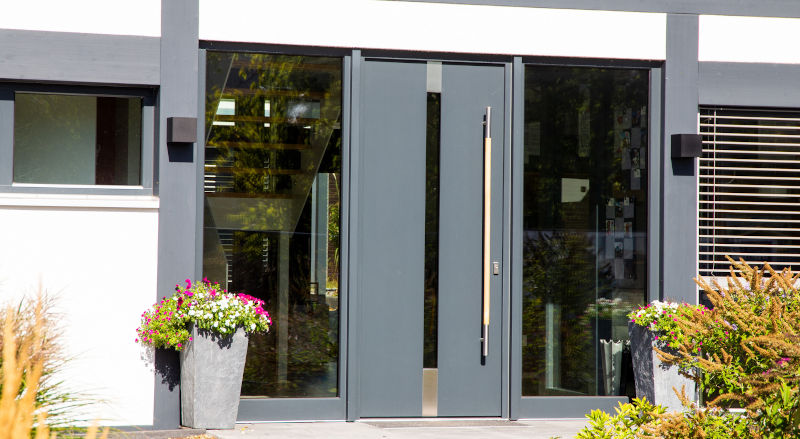
CCW's modern front door collections
CCW's steel entry doors are offered in four collections, each suited to a different design direction. All four can be specified with modern detailing, flush panels, full-glass inserts, contemporary hardware, and modern colours, though each collection has a distinct character.
Shaker collection
Inspired by Shaker furniture, this collection emphasizes clean lines, recessed panels, and simple geometric proportions. The Shaker style fits both modern and transitional homes — it's clean enough for a contemporary build but adaptable to homes that aren't purely minimalist. Often specified with full-light or ¾-light glass inserts to give a more contemporary feel.
Design collection
The Design collection is CCW's most contemporary product line, featuring flush panels, asymmetric glass arrangements, oversized pulls, and bold colour options. Best suited to modern new builds, architecturally significant renovations, and homes where the front door is intended as a design statement.
Prestige collection
The Prestige collection is CCW's premium-tier line, offering larger door sizes, more elaborate glass configurations (often with sidelites and transoms integrated as standard), upgraded hardware, and the broadest range of customization options. Suits high-end custom homes and major renovations where the entry is a centrepiece feature.
Classic collection
The Classic collection serves traditional and transitional homes with raised panels, more conventional glass inserts, and warm wood-grain finishes. Less suited to purely modern aesthetics, but is commonly paired with modern hardware and colour finishes to give a traditional door a contemporary update.
Within all four collections, steel construction, insulated cores, multi-point locking, weatherstripping, and the 25-year transferable warranty are consistent. The differences are in design, hardware, and customization range.
Customization options
Every CCW entry door is made to order. The customization layers available:
- Size: standard residential sizes plus oversized configurations for taller or wider openings.
- Colour: full range of factory finishes from the trending palette above. Dual-tone options available (different exterior and interior colours).
- Glass: clear, frosted, textured, etched, or patterned. Multiple lite configurations — full-light, ¾-light, half-light, 3-lite or 5-lite arrangements.
- Hardware: gripsets, levers, knobs, and deadbolts in a range of finishes. Smart lock integration available.
- Sidelites and transoms: full or partial-glass extensions on either side of the door, or above it.
- Grille options: applied or between-glass grilles for traditional collections; geometric or no-grille options for contemporary collections.
What drives the cost of a modern front door
Pricing on a custom-built steel entry door varies significantly based on the configuration. The cost drivers in roughly the order they affect the final number:
- Collection tier: Shaker and Classic are CCW's most accessible tiers; Design and Prestige carry premium pricing reflecting more elaborate construction and customization.
- Door size: oversized doors (over 36 inches wide or floor-to-ceiling heights) cost more in both materials and installation.
- Glass package: more glass area, premium glass treatments (etched, textured, decorative), and triple-pane Low-E configurations add to the cost.
- Sidelites and transoms: each adds to the total cost of the opening assembly.
- Hardware: standard mechanical hardware is included in the base price; smart locks, decorative pulls, and concealed-hinge systems add to the cost.
- Installation complexity: replacing an entry door in an older home with rough or non-standard openings adds labour.
- Location: pricing varies across Canadian markets.
A meaningful quote requires an in-home consultation. CCW's consultation is free and non-obligatory. The project manager measures the opening, reviews the structural condition, and walks through configuration options before providing a quote.
“On a modern entry door project, the conversation usually starts with what the homeowner wants the door to feel like — the visitor's first impression. We work backward from that: colour, glass arrangement, hardware, sidelites. The structural assessment of the opening matters just as much. A great door installed in a poorly framed opening doesn't perform — we check that first.”
— Tony Wong, Project Manager, Canadian Choice Windows & Doors
Why Canadian homeowners choose CCW for modern front doors
Canadian Choice Windows & Doors has been serving Canadian homes for over 40 years. Every steel entry door is manufactured in Canada at our facility, custom-built to your exact opening, and installed by our own in-house teams — no subcontractors.
- Recommended by Bryan Baeumler, HGTV host and Canada's recognized construction expert.
- Over 3,100 positive reviews on HomeStars.
- More than 1 million windows and doors have been installed across Canada.
- 25-year transferable warranty on every entry door.
- Four entry door collections: Shaker, Design, Prestige, and Classic, covering modern, transitional, and traditional aesthetics.
- DraftLOCK sealing technology is built into every door for performance in the Canadian climate.
- Cardinal IG and Guardian Glass insulated glass units with Low-E coatings.
- ASTM-approved acrylic sealing system bonding glass units to sashes.
- ENERGY STAR and CSA-compliant configurations available.
- A dedicated project manager guides every project from in-home consultation through installation.
Frequently asked questions
What makes a front door "modern"?
Modern front doors are defined by clean lines, minimalist hardware, larger glass surfaces, bold colour, and a deliberate reduction of decorative detail. They contrast with traditional doors that emphasize raised panels, carved millwork, and ornate glass inserts. The materials matter too — modern doors are typically built around insulated steel or composite cores rather than solid wood.
What's the best material for a modern front door?
For Canadian homes, steel is the practical choice. Insulated steel doors deliver strong security, excellent thermal performance thanks to their foam cores and thermal breaks, and durability during Canadian freeze-thaw cycles. Fibreglass and wood are also available through other Canadian suppliers; CCW manufactures steel entry doors only.
Are modern front doors more secure than traditional ones?
Generally, yes, but not because they look modern. Modern doors are more often built with multi-point locking systems, reinforced strike plates, impact-resistant glass, and steel-skinned construction with insulated cores. Older traditional doors can be just as secure if they include these features; newer modern doors usually do.
What colours are trending for modern front doors in 2026?
Matte black remains the strongest single modern colour. Sage green is the fastest-growing trend, particularly in renovations. Navy blue, deep red, charcoal grey, and warm wood-grain finishes are all common choices on contemporary homes. Dual-tone doors (with different exterior and interior colours) are increasingly specified for custom orders.
Are pivot doors practical for Canadian climates?
They can be, but with caveats. Pivot doors require precise installation and high-quality hardware to handle the door's full weight on a central axis. The threshold seal works differently from a standard hinged door, and weatherstripping needs to be carefully planned. Pivot doors are most common in custom homes; for a typical Canadian replacement project, a standard hinged door is more practical and significantly less expensive.
How much glass can I have on a front door without losing energy efficiency?
Modern Low-E-coated double- or triple-pane glass packages perform well even on full-light doors. The energy impact comes from three factors: the glass itself (the quality of the Low-E coating and gas fill), the spacer system between the panes, and the seal between the glass unit and the door frame. A quality full-light steel door with a triple-pane insulated glass package can outperform a basic double-pane door with no glass.
Are smart locks worth installing on a front door?
For most homeowners, yes — particularly families with multiple users, frequent guests, or short-term rental considerations. The main features that justify smart locks are keypad entry (no spare keys), activity logs, and integration with home automation. The lock is only as secure as the door it's installed in, so installation quality matters more than the lock brand.
How long do modern steel front doors last?
Quality steel entry doors typically last 25 to 30 years or more with regular maintenance. Lifespan depends on the door's construction quality, installation precision, and ongoing care. CCW's 25-year transferable warranty stays with the home if you sell it, which is meaningful for resale value.
What's the difference between CCW's entry door collections?
CCW offers four collections: Shaker (clean lines, transitional), Design (most contemporary, asymmetric, modern), Prestige (premium-tier with elaborate glass configurations and broadest customization), and Classic (traditional and transitional with raised panels). All four are built on a steel frame with insulated cores; the differences lie in design, glass options, hardware, and customization range.
Designing a modern front entry?
Book a free, no-obligation in-home consultation with Canadian Choice Windows & Doors. We'll walk through the right collection for your home, take exact measurements, and explain the colour, glass, and hardware options that suit your design without pressure.

1000’s of Colours & Textured Finishes
Transform your home from ordinary to extraordinary with our new coloured and non-glare textured finishes. Available in a wide array of colours as well as custom matched colours for your very own personalized design.
Our Most Popular Replacement Window Colours: