Virgin Vinyl vs Recycled Vinyl Windows: What’s the Difference?


Key Takeaways
- Virgin vinyl is PVC that has never been processed before, offering consistent material composition and predictable performance across its lifespan.
- Recycled vinyl or regrind content introduces material variability depending on the source, processing method, and proportion of recycled content used in the profile.
- A peer-reviewed study published on ResearchGate found that profiles made from 100% virgin PVC showed superior thermal and mechanical characteristics compared to profiles containing a percentage of recycled PVC, when tested under the European window profile standard NF EN 12608-1.
- Frame design, reinforcements, glazing, seals, and installation quality all affect the final performance of any vinyl window, regardless of whether the base material is virgin or recycled.
- The sustainability argument for recycled vinyl windows is not straightforward: a longer-lasting virgin vinyl window can reduce replacement frequency and total lifecycle waste compared to a lower-quality recycled-content product replaced sooner.
- In Canada, post-consumer vinyl window recycling infrastructure is still in early development, meaning most recycled content in current window profiles comes from production regrind rather than end-of-life consumer windows.
If you are comparing virgin vinyl windows against recycled vinyl windows, the short answer is that virgin vinyl offers more predictable and consistent material performance, while recycled content introduces variability that depends on the source, the processing method, and the proportion used. That variability matters in Canada, where window frames face freeze-thaw cycling, UV exposure, and decades of thermal stress. It does not mean recycled-content windows are automatically inferior: a well-engineered frame with reinforcement, quality glazing, and proper installation can perform well regardless of the base resin. But when you are making a purchase that needs to last 25 to 30 years, understanding the material difference is a practical starting point.
This guide explains what virgin vinyl, recycled vinyl, and regrind actually mean; how the choice of material affects durability, appearance, energy efficiency, and environmental impact; and how to make a confident decision for your Canadian home.
Virgin Vinyl vs Recycled Vinyl: Key Definitions
The terms virgin vinyl, recycled vinyl, regrind, PVC, and uPVC are often used interchangeably in marketing materials, but they refer to meaningfully different things. Understanding the distinctions helps you ask the right questions when comparing products.
Virgin vinyl meaning
Virgin vinyl refers to polyvinyl chloride (PVC) manufactured from new raw materials and never processed, extruded, or used before. Because it starts from a consistent feedstock, virgin vinyl has a predictable chemical composition and well-defined mechanical properties. Manufacturers of window profiles made from virgin PVC can precisely formulate the material by adding stabilizers, impact modifiers, and UV inhibitors in controlled proportions to achieve specific performance targets. The term uPVC, which stands for unplasticized polyvinyl chloride, refers to virgin vinyl that has not been softened with plasticizers, making it rigid and suitable for structural applications such as window frames. In practice, virtually all window-grade vinyl, whether virgin or recycled, is uPVC in the sense that it is rigid rather than flexible. However, when a supplier describes their product as virgin uPVC, they mean the base resin has never been reprocessed.
Recycled vinyl meaning
Recycled vinyl in the context of window profiles typically refers to one of two things. The first is post-industrial regrind: material that was trimmed, rejected, or left over during the manufacturing process and then reground and reintroduced into the extrusion line. This is the most common form of recycled content in current vinyl window profiles. The second is post-consumer recycled content: material recovered from end-of-life windows and reprocessed into new profiles. Post-consumer content introduces greater variability because the source material has been exposed to UV radiation, temperature cycling, and chemical stabilizers during its previous lifespan, altering its molecular structure and reducing predictability. The proportion of recycled content in a profile can range from a small percentage of regrind in an otherwise virgin frame to a substantially higher share, and suppliers are not always transparent about this ratio in their product literature.
Vinyl window material types: quick reference

| Term | What It Means | Key Characteristic |
|---|---|---|
| Virgin PVC | New, never-processed PVC resin | Consistent; predictable properties |
| uPVC | Unplasticized PVC (rigid, not flexible) | Standard for window frames; can be virgin or recycled |
| Post-industrial regrind | Manufacturing offcuts are reground and reused | Low variability; common in most vinyl windows |
| Post-consumer recycled | Reclaimed from end-of-life windows or products | Higher variability; limited Canadian infrastructure |
| Virgin uPVC | Rigid PVC from new raw materials; never reprocessed | Highest consistency; preferred for premium profiles |
Why Does Vinyl Quality Matter for Canadian Windows?
Canadian weather subjects window frames to stresses that most other climates do not. The material consistency of the frame directly affects how well it handles those stresses over decades.
Why climate matters for window frames
A window frame in Canada endures repeated freeze-thaw cycling every year. In Ontario, Manitoba, or the Prairies, a frame may transition from sub-zero temperatures to above-zero temperatures multiple times within a single day during transitional seasons. PVC expands and contracts with temperature changes, and the precision of its dimensional movement depends on the material's consistency. A frame made from a uniform, well-stabilized virgin PVC formulation responds predictably to thermal cycling, maintaining its geometry and keeping the sash aligned against the weatherstripping. A frame with variable recycled content may respond less uniformly, which over many cycles can lead to minor dimensional changes that affect how tightly the sash seats in the frame.
UV exposure is a second significant factor. Canadian summers involve long periods of direct sun, particularly for south and west-facing windows. PVC degrades under UV radiation through a process called photodegradation, which causes the surface to yellow, chalk, and lose impact resistance over time. Virgin vinyl formulations can be stabilized with precisely dosed UV inhibitors because the base material is chemically consistent. Recycled content, particularly post-consumer material with unknown UV history, may already have partially degraded stabilizers, which reduces the effectiveness of additional inhibitors and accelerates surface ageing. The visible consequence is that recycled-content frames may yellow or chalk sooner than virgin PVC frames of equivalent thickness and profile design.
Moisture management is a third consideration. PVC is inherently moisture-resistant, which is one of its primary advantages over wood. However, the quality of the frame joints and the precision of the welded corners determine whether the frame remains moisture-tight where the profile sections meet. Frames with consistent material properties achieve more uniform welds. Variable-composition recycled material can produce welds with micro-inconsistencies that become potential points of water ingress over time, particularly in climates with heavy rain, ice damming, or freeze-thaw stress at the joints.
“In a Canadian climate, the frame goes through more stress cycles in a single year than window frames in most of the world. Material consistency is not an abstract quality attribute; it directly determines whether the frame holds its shape and its seal through twenty winters. That is why we use virgin vinyl for our profiles.” — Tony Wong, Project Manager at Canadian Choice Windows & Doors
Are Virgin Vinyl Windows More Durable?
Based on both material science and independent testing, virgin PVC profiles demonstrate more consistent thermal and mechanical performance than profiles containing recycled content. However, frame design, reinforcements, and manufacturing quality also significantly affect the final result.
A peer-reviewed study published on ResearchGate , titled “Comparative Evaluation of Virgin and Recycled PVC Profiles Quality,” directly tested this question. The study conducted thermal and mechanical tests on four-chamber window profiles: one composed of 100% virgin PVC and one containing a percentage of recycled PVC. Tests included heat reversion, resistance to impact by falling mass, weld corner strength, and appearance after conditioning. The results showed that profiles made from 100% virgin PVC exhibited superior thermal and mechanical characteristics, meeting all requirements of NF EN 12608-1. Profiles containing recycled PVC met the heat reversion test but showed inferior performance across the other mechanical assessments. The study also noted that melt viscosity varied among different batches of recycled material, confirming that batch-to-batch consistency is a meaningful challenge for profiles using post-consumer or variable-source recycled content.
These findings reflect the underlying material science: recycled PVC has undergone previous thermal processing, which shortens the polymer chains and can reduce impact strength and thermal stability. Post-consumer material adds the further complication of unknown exposure history and potential contamination. For a window frame expected to perform for 25 to 30 years in Canadian conditions, starting with a material that has demonstrably more consistent and predictable properties is a practical advantage, not merely a marketing claim.
It is important to note that frame design mitigates some of this difference. A well-engineered multi-chamber profile with steel or fibreglass reinforcement can compensate for some degree of variability in the base material. Reinforced frames with structural inserts resist deflection and maintain sash alignment, regardless of whether the surrounding PVC is virgin or recycled. This is why the material type alone does not fully predict the performance of a finished window: the profile engineering, the quality of the welded corners, and the installation all contribute to the outcome.
How Do They Compare in Appearance Over Time?
Long-term appearance is one of the most visible differences between virgin and recycled vinyl windows. Virgin PVC formulated with appropriate UV stabilizers maintains a cleaner, whiter surface for longer than recycled-content vinyl, particularly when the recycled material has an unknown UV exposure history.
New vinyl windows in both categories typically look similar: a smooth, uniform white or off-white surface. The difference emerges over years of UV exposure. Photodegradation causes the PVC surface to undergo several visible stages: initial yellowing as stabilizers are consumed, followed by surface chalking as the degraded layer becomes powdery, and eventually embrittlement as the surface layer's impact resistance decreases. In a well-formulated virgin PVC profile, the UV stabilizer package is precisely dosed and uniformly distributed throughout the material. The ageing process is slower and more predictable. In a profile with recycled content, particularly post-consumer material, the stabilizer package in the original material has partially been depleted by its previous service life. Reprocessing adds heat history, which further degrades the remaining stabilizers.
The practical consequence for a Canadian homeowner is straightforward: a premium virgin vinyl window installed today is more likely to still look clean and white in fifteen years than a lower-grade recycled-content window of the same original colour. This matters aesthetically and at resale. A window that has yellowed or chalked before the end of its mechanical service life detracts from curb appeal and signals to potential buyers that maintenance may be needed.
Appearance factors: virgin vs recycled vinyl over time
| Appearance Factor | Virgin Vinyl | Recycled Vinyl (variable content) |
|---|---|---|
| Initial colour quality | Uniform, consistent white | Generally similar initially |
| UV yellowing risk | Lower; stabilizers precisely dosed | Higher stabilizers may be partially depleted |
| Surface chalking timeline | Slower; more predictable | Can occur sooner with high post-consumer content |
| Surface embrittlement | Lower risk; consistent polymer chains | Higher risk with degraded recycled material |
| Long-term colour retention | Generally better | Depends heavily on the recycled content proportion |
| Colour coating adhesion | Consistent substrate | May vary with surface quality |
Does Recycled Vinyl Always Mean Lower Quality?
Not automatically. Recycled content introduces variability, but a well-engineered window with recycled-content frames can still perform adequately if the profile design, reinforcements, glazing, and installation compensate for material limitations. The key is understanding what “recycled” actually means in a specific product.
The most important distinction is between post-industrial regrind and post-consumer recycled content. Post-industrial regrind is trim waste and production offcuts from the same manufacturing process. It has not been exposed to UV, temperature cycling, or chemical degradation in service, and its composition is relatively consistent because it comes from the same production run. Windows made with a modest proportion of post-industrial regrind in an otherwise virgin formulation often perform very close to all-virgin profiles. The variability is low, and the manufacturing process is controlled.
Post-consumer recycled content is a different situation. Material recovered from end-of-life windows has a variable history of UV exposure, different original formulations, potential contaminants, and degraded stabilizer packages. In Canada, post-consumer vinyl window recycling infrastructure is still in its early stages: the Vinyl Institute of Canada, in partnership with the National Research Council of Canada, launched Project Win-Finity in June 2025 to establish a circular recycling system for post-consumer PVC windows in the Greater Toronto Area. The program is designed to evaluate a recycled-content model for vinyl windows and to set the stage for broader recycling systems across Canada. The fact that this infrastructure is only now being developed confirms that most recycled vinyl content in current window profiles comes from production regrind rather than from end-of-life consumer windows.
For homeowners evaluating a window product described as using recycled content, the practical questions are: what type of recycled content, what proportion, and how does the manufacturer compensate for the variability through reinforcement and frame engineering? A supplier who cannot answer these questions clearly is worth treating with caution.
“The word ‘recycled’ can mean several very different things on a spec sheet. There is a big difference between production regrind in a controlled proportion and variable post-consumer material with unknown history. We are always direct with homeowners about what is in our frames, because the material specification is part of what justifies the warranty we offer.” — Helen Sin, Consumer Success Manager at Canadian Choice Windows & Doors
How Does Frame Material Affect Energy Efficiency?
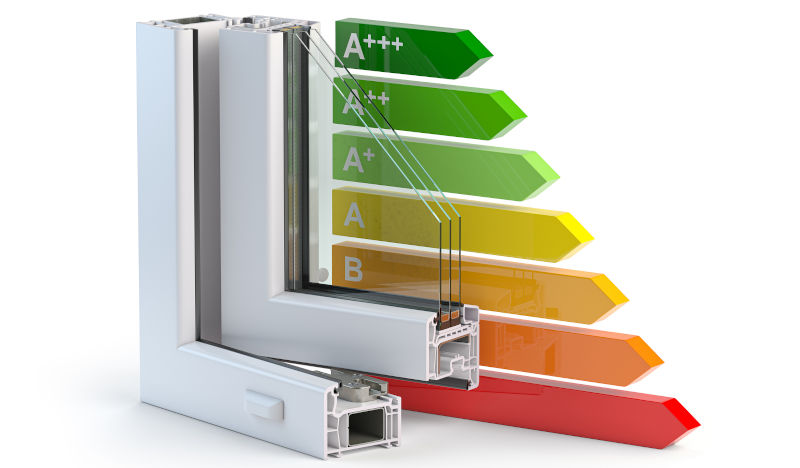
The base vinyl material, whether virgin or recycled, does not directly determine the window's energy efficiency. Energy performance is a function of the complete assembly: frame chamber design, sealing systems, glass specification, Low-E coatings, gas fills, and spacer quality. All contribute more to the thermal outcome than whether the PVC resin is virgin or recycled.
Vinyl frames are thermally beneficial compared to metal frames because PVC has inherently low thermal conductivity, which minimizes heat transfer through the frame section itself. This applies equally to virgin and recycled vinyl. What the multi-chamber frame design adds is a series of trapped air pockets within the frame profile that further slow heat transfer from the warm interior to the cold exterior. The number and arrangement of chambers and the quality of the internal walls between them affect the frame’s thermal performance independently of the base material type.
The glass unit dominates the energy performance of any window. A triple-pane unit with a passive Low-E coating, an argon or krypton gas fill, and a warm-edge spacer delivers meaningfully better thermal performance than a standard double-pane unit, regardless of whether the surrounding frame is virgin or recycled vinyl. The vinyl windows at Canadian Choice Windows & Doors include triple glazing, Low-E coating technology, and thermally optimized frame chambers as part of their standard specification, with the frame made from virgin vinyl to ensure consistent manufacture.
The base material affects energy performance indirectly through the quality of the welded corners and the long-term integrity of the sealing system. A frame made from consistent virgin PVC produces more uniform welds at the corners, the most vulnerable points for air infiltration. A frame with variable recycled content may produce welds with micro-inconsistencies. Over time, any gap at a corner joint allows air to bypass the weatherstripping, reducing the assembly's effective airtightness and resulting in heat loss that does not show up in the glass unit’s rated performance.
Which Material Resists Warping, Cracking, and Fading Better?
Virgin vinyl formulated specifically for window profiles offers more predictable resistance to warping, cracking, and fading than variable-composition recycled vinyl. Frame reinforcements and multi-chamber design help both types, but they cannot fully substitute for the material consistency advantage of virgin PVC.
Warping is caused by uneven thermal expansion and contraction. A frame section with slightly inconsistent material composition across its cross-section will expand and contract unevenly with temperature changes, creating internal stresses that gradually deform the profile. Virgin vinyl, because its composition is uniform from surface to core, expands and contracts uniformly. Recycled-content profiles, particularly those incorporating post-consumer material with variable polymer chain lengths, are more susceptible to differential expansion.
Cracking is caused by impact or by thermal embrittlement. PVC becomes more brittle at low temperatures, which is directly relevant in Canadian winters. The impact modifiers added to window-grade vinyl reduce brittleness, but their effectiveness depends on their uniform distribution throughout the material at consistent concentrations. In virgin PVC, this is achieved through controlled formulation. In recycled-content PVC, the impact modifier distribution depends on how well the recycled material is compounded with the virgin base, introducing variability.
Fading and discolouration, as discussed in the appearance section, are driven by UV degradation of the stabilizer system. High-quality reinforced and welded vinyl window frames are specifically engineered to resist fading, cracking, warping, and long-term discolouration through the use of stable virgin vinyl compounds and structural reinforcement. Reviewing the warranty of any window product for explicit coverage of these failure modes is a practical step before purchasing: a warranty that excludes fading and discolouration tells you something about the manufacturer’s confidence in the material.
| Performance Risk | Virgin Vinyl | Recycled Vinyl (variable content) | Mitigated By |
|---|---|---|---|
| Warping under thermal cycling | Lower risk; uniform expansion | Higher risk; variable composition | Steel or fibreglass reinforcement |
| Cracking at low temperature | Lower risk; consistent modifiers | Higher risk; variable impact mod. | Multi-chamber design; reinforcement |
| UV fading/yellowing | Lower risk; dosed stabilizers | Higher risk; degraded stabilizers | UV-resistant coatings; colour films |
| Corner weld failure | More uniform weld quality | Potential micro-inconsistencies | Quality control: weld strength testing |
| Surface chalking | Slower; more predictable | Can accelerate with post-consumer | Exterior surface treatments |
Is Virgin Vinyl Worth the Extra Cost?
For most Canadian homeowners, the answer to replacing windows in a home they plan to occupy long-term is yes. The additional upfront cost of virgin vinyl windows reflects a material specification that is more likely to maintain its performance and appearance across the 25- to 30-year lifecycle of the product.
When paying more makes sense
The economic argument for virgin vinyl is strongest when the ownership timeline is long, the climate exposure is severe, and appearance retention matters. A homeowner in Winnipeg planning to stay in their home for twenty years is making a very different calculation from a homeowner in Victoria who may sell in five years. For the long-term owner in a cold climate, the combination of better thermal cycling resistance, longer appearance retention, and the warranty protection that a manufacturer offers on a virgin vinyl product adds up to a meaningful difference over the replacement cycle. The avoided cost of an early window replacement or extended maintenance to manage chalking and discolouration is not trivial when multiplied across all the windows in a home.
When budget matters more
For a homeowner on a tight budget replacing all the windows in a large home, or for a rental property where appearance retention and comfort are secondary to function, a well-engineered recycled-content window from a reputable supplier with a clear material specification may be an appropriate choice. The key is transparency: a product that specifies the proportion of post-industrial regrind in a controlled virgin-based formulation is a different proposition from a product that vaguely references recycled content without disclosing the source or proportion. Budget should not be the only deciding factor, but it is a legitimate consideration when the alternative is deferring a necessary replacement.
The long-term value comparison also includes warranty coverage. A 25-year transferable warranty , such as the one offered on Canadian Choice Windows & Doors vinyl windows, is both financial protection and a signal of manufacturer confidence, applying across the full expected lifespan of the product. A shorter or more limited warranty on a lower-cost recycled-content window may shift the financial advantage over a 25-year horizon even if the day-one price is lower.
Are Recycled Vinyl Windows More Environmentally Friendly?
The environmental discussion around virgin and recycled vinyl is more nuanced than it may initially appear. Using recycled material can reduce demand for new raw resources, but durability and long-term performance also matter. A lower-quality window that requires replacement sooner can ultimately generate more waste and consume more manufacturing energy over time than a longer-lasting, higher-performing product.
Vinyl is a durable material regardless of formulation, which means the window's lifespan becomes one of the most important sustainability factors. Keeping windows in service for decades reduces replacement frequency, minimizes material consumption, and lowers the environmental impact associated with manufacturing and disposal. For homeowners focused on sustainability, the most practical approach is often to choose a well-built, energy-efficient window designed for long-term performance, while ensuring old windows are properly recycled or diverted from landfills wherever possible.
Virgin Vinyl vs Recycled Vinyl: The Verdict
For Canadian homeowners who want windows that will perform consistently across freeze-thaw cycling, UV exposure, and decades of thermal stress, virgin vinyl is the more reliable material choice. The performance advantage is supported by independent material testing, and it is most meaningful in climates and ownership situations where long-term consistency matters more than upfront cost.
Recycled-content windows are not automatically poor products. A well-engineered frame using controlled proportions of post-industrial regrind in a virgin-based formulation can perform well, and transparency from the supplier about the material specification is the key indicator of quality. What should give homeowners pause is a product that references recycled content without disclosing the proportion or source and that does not offer warranty coverage for the specific failure modes, such as warping, cracking, fading, and discolouration, that are most affected by base material quality.
The most practical advice is to ask directly: what is in this frame, and what does the warranty cover? A supplier who answers clearly, as the team at Canadian Choice Windows & Doors does with its virgin vinyl, reinforced, welded-frame products, is giving you the information you need to make a confident long-term decision.
Frequently Asked Questions
How can I tell if a window is made from virgin or recycled vinyl?
Ask the supplier directly and request written confirmation of the material specification. Reputable manufacturers are transparent about their vinyl source. Red flags include vague language such as “high-quality vinyl” without specifying whether it is virgin or recycled, and warranty terms that exclude fading, discolouration, or warping, which are the failure modes most associated with lower-grade recycled content.
Does recycled vinyl look different from virgin vinyl when new?
Generally, no, when new. Both types can be manufactured with a similar surface finish and colour. The difference in appearance becomes visible over years of UV exposure, when recycled-content profiles, particularly those with post-consumer material, tend to yellow and chalk sooner than well-stabilized virgin vinyl profiles.
Is uPVC the same as virgin vinyl?
Not exactly. uPVC refers to unplasticized PVC, meaning rigid PVC without softening plasticizers, which is the correct specification for window frames. Virgin vinyl refers to PVC that has never been reprocessed. A window can be described as uPVC and still contain recycled content. When a supplier specifies virgin uPVC, they are stating that the material is both rigid and sourced from new, never-reprocessed resin.
Can reinforced frames compensate for lower-quality recycled vinyl?
Partially. Steel or fibreglass reinforcement in the structural sections of a frame significantly improves resistance to deflection and sash misalignment, regardless of the base PVC quality. However, reinforcement cannot fully address UV-related surface ageing, colour change, or weld-quality variability arising from inconsistent recycled-content feedstock. The best outcome comes from combining reinforcement with a consistent, well-formulated base material.

1000’s of Colours & Textured Finishes
Transform your home from ordinary to extraordinary with our new coloured and non-glare textured finishes. Available in a wide array of colours as well as custom matched colours for your very own personalized design.
Our Most Popular Replacement Window Colours: