Sliding Patio Doors vs Hinged Doors: Which Saves More Interior Space?
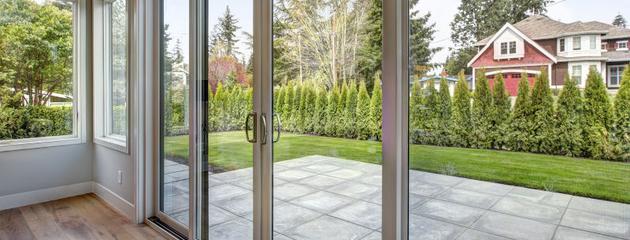

If you're trying to decide between a sliding patio door and a hinged door, the short answer is this: Sliding doors save more interior space in most homes. A sliding door moves along a track and stays within its own frame line, meaning it never takes up floor area when opening or closing. A hinged door, by contrast, needs a clear swing arc that can reach up to 1.2 metres, depending on the door size. That area should stay free of furniture and obstacles so the door can open safely and comfortably. That said, the right choice still depends on your room layout, how you use the space, and what you want the opening to look like. This guide breaks it all down so you can make the decision with confidence.
Key takeaways
- A sliding patio door moves horizontally along a track and requires no swing clearance, making it the practical choice for tight spaces, condos, and compact dining areas.
- A hinged or French-style door may be the better fit in larger rooms where a full-width opening or traditional exterior style is the priority.
- Standard hinged doors require between 0.8 and 1.2 metres of clear swing space in front of them — a floor area that needs to stay clear of furniture and other obstacles so the door can open fully.
- Sliding patio doors with insulated vinyl frames and multi-pane glass can qualify for ENERGY STAR certification and perform well in Canadian winters.
- Security depends more on hardware quality and professional installation than on door style.
- As a general budgeting range, patio door replacement in Canada can start around $1,500 and exceed $5,000, depending on size, glass package, frame finish, hardware, and installation complexity. A project-specific quote is the only reliable way to confirm the final cost.
What is the main difference between a sliding door and a hinged door?
The core difference is how each door opens. That single difference has a ripple effect on floor space, furniture layout, traffic flow, and how the room feels day to day.
How sliding doors work
A sliding patio door operates on a horizontal track. One panel is fixed, and the other moves, gliding parallel to the wall. The moving panel slides behind or in front of the fixed panel, depending on the design.
Because the door never extends into the room, the floor plan in front of it stays fully usable. You can place furniture close to the door frame, run a rug up to the threshold, or keep a clear walkway without carving out any dedicated swing space.
Sliding patio doors typically come in widths from 1.5 metres (around 5 feet) to over 2.4 metres (8 feet), and they are commonly used for patio, deck, and balcony access because they are simple to operate and do not interfere with the room’s layout. At Canadian Choice Windows & Doors, sliding patio doors are built with insulated vinyl frames to withstand Canada's climate while keeping day-to-day use simple and practical.
How hinged doors work
A hinged patio door is attached to the frame on one or both sides. When you open it, the door swings inward, outward, or both, depending on the configuration. A single-hinged door swings in one direction. French doors have two hinged panels — typically swinging open from the centre, either both inward, both outward, or in opposite directions.

The key limitation is the swing arc. Every hinged door needs a clear space equal to its full width in the direction it swings. A standard 90 cm door swinging inward needs 90 cm of clearance in front of it, and that zone must remain permanently free.
For rooms with generous space, that clearance is easy to accommodate. In smaller rooms, it eliminates entire areas from practical use.
| Feature | Sliding patio door | Hinged / French door |
|---|---|---|
| How it opens | Slides horizontally on a track | Swings inward or outward on hinges |
| Swing clearance required | None | 0.8 to 1.2 m in swing direction |
| Typical width range | 1.5 m to 3.0 m | 0.8 m (single) to 1.8 m (French pair) |
| Full opening width | Roughly half the door width | Full frame width (French doors) |
| Best for | Compact spaces, balconies, walkouts | Larger rooms, traditional exteriors |
| Screen included | Typically yes | Optional, sometimes an additional cost |
Why does door swing matter when planning interior space?
A door's swing affects more than just one corner of a room. It shapes where furniture can go, how people move through the space, and whether the room feels open or cramped.
Swing radius
A hinged door's swing radius is simply its width. A 90 cm door sweeps a 90 cm arc when opened fully. That arc defines a zone that must stay clear at all times — not just when the door is open, but also to allow it to be opened without moving anything.
For French doors in a 1.5 m opening, both panels swing inward. That can occupy close to 1.5 square metres of floor space in front of the door, which is roughly the footprint of a small dining table.
Sliding doors eliminate this entirely. The only space they need is the track channel at the floor, which is flush and poses no practical obstacle.
Furniture clearance
Furniture placement near a patio door depends almost entirely on clearance requirements.
With a sliding door, a sofa, dining bench, or storage cabinet can sit within a few centimetres of the door frame without any concern. The only practical boundary is leaving a comfortable walkway to reach the handle.
With a hinged door, all furniture must sit outside the swing arc. That means:
- No chairs placed near the door that would block it from swinging open
- No rugs that bunch up under the door sweep
- No storage units or plants placed in the arc path
- A permanent corridor of empty floor space in front of the door
In a dining room where a table and chairs are close to the patio opening, this clearance requirement can force the entire furniture arrangement to shift away from the door wall.
Traffic paths
Traffic flow through a room is partly shaped by where doors open and close. A hinged patio door, when open, extends into the room and narrows the walkway beside it. In a dining area or narrow kitchen, this can make movement awkward, particularly when guests are moving between the indoors and the patio.
A sliding door creates no obstacle in the open position. The clear opening is fully usable for movement, which makes it the more practical choice in spaces where multiple people need to move through the doorway at the same time.
Is a sliding door vs. a hinged door comparison more important for small rooms?
Yes, in a meaningful way. In a large, open-concept main floor with generous square footage, a hinged door's swing arc occupies only a small fraction of the total space. It's inconvenient but manageable.
In small rooms, that same arc becomes a serious design problem.
Small dining rooms
A compact dining room with a patio walkout is one of the most common situations where the door type directly limits what's possible. A dining table with four chairs can measure 90 cm x 150 cm or more. If a hinged door swings into that room, it can be impossible to place the table anywhere close to the door without conflicting with the arc.
A sliding patio door solves this immediately. The table can sit anywhere in the room because the door does not intrude on the floor plan.
Condo balconies
Condos represent the clearest argument for sliding doors. In a condo, the balcony access point is usually in a living area or bedroom where every square metre matters. Adding a hinged door that sweeps inward would consume a significant portion of usable floor space.
Sliding patio doors are standard in most Canadian condo construction for exactly this reason. The door slides open and closed within its own frame line, leaving the entire floor plan intact.
Narrow walkouts
Narrow walkouts from kitchens, mudrooms, or lower-level rooms present a similar challenge. In a galley-style kitchen with a side walkout, a hinged door that swings inward would block access to the cabinets or cut off the walkway entirely.
A sliding door allows the same doorway to function without altering the room's usable space at all.
When can a hinged door still be the better layout choice?
Sliding doors don't win in every situation. There are specific cases where a hinged or French-style door is the better fit, and knowing those cases prevents choosing the wrong option for the wrong reasons.
In larger living rooms, great rooms, and traditional detached homes with generous floor plans, the swing clearance of a hinged door is easy to accommodate. In those spaces, the case for a hinged door often rests on two things: the quality of the opening width and the exterior appearance.
French doors open to the full width of the frame when both panels are swung back. That creates a seamless transition from indoors to outdoors — one wide enough to carry furniture through or to create a dramatic effect when entertaining. Sliding doors, by contrast, open only to roughly half the frame width because one panel is always fixed.
Homeowners who prioritize a traditional or heritage exterior aesthetic often prefer the look of French doors. The panel-and-rail design, visible hinge hardware, and the way they frame the opening carry a classic quality that sliding doors don't replicate.
“French doors give homeowners a grander entry point to their outdoor space, and when the room can absorb the swing clearance, that wider opening is genuinely useful for entertaining or moving larger items in and out.” — Helen Sin, Consumer Success Manager at Canadian Choice Windows & Doors
That said, the exterior design benefit comes with trade-offs. In any room where floor space is limited, a hinged door will always require a compromise on furniture placement.
A hinged or French door tends to be the better fit when:
- The room is a large open-concept living area or great room where swing clearance is easy to absorb
- The home has a traditional or heritage exterior, and French-door styling matches the architecture
- A full-width outdoor opening is genuinely needed — for moving furniture, entertaining at scale, or creating an indoor-outdoor flow
- The doorway is 1.8 m or wider, where a French pair provides better visual proportion than a single sliding panel
How do sliding and hinged patio doors affect furniture placement?
This is where the theory becomes practical. Most homeowners don't think about door swing when arranging furniture — until the first time they try to open the door and find a dining chair in the way.
Furniture near a sliding door
The relationship between furniture and a sliding door is straightforward. The door opens and closes within its frame. The only practical consideration is keeping the walkway clear so you can reach the handle and step through the doorway.
This means:
- A sofa can face the patio door without any issue
- A dining table can sit within arm's reach of the threshold
- Rugs can extend right up to the threshold
- Planters, storage benches, or side tables can sit near the frame without conflicting with the opening
The one thing to avoid is placing furniture directly in the walkway once the door is open, but that's simply a traffic-flow consideration, not a clearance requirement.
Furniture near a hinged door
With a hinged door, furniture placement in the door zone requires planning. The swing arc creates an exclusion zone — a section of floor where no permanent furniture can sit.
A practical rule is to mark the arc on the floor before arranging furniture. Trace the door's full swing from the hinge point to the outer edge of the door at the maximum open position. That entire zone must stay clear.
In a dining room where the door swings inward, this often means:
- The dining table must sit at least one full door width away from the door wall
- Chairs on the door-side of the table need to be pulled back carefully before opening
- Area rugs must not extend into the arc, or the door will catch on them
Common layout mistakes
Several layout problems recur when homeowners don't account for door swing.
The most common is placing a chair or bench seat directly in the swing path. When the door is closed, it looks perfectly placed. When someone tries to open the door fully, the chair blocks it, and the door can only open halfway.
Another frequent issue is laying a thick rug that extends under the door sweep. The door catches the edge of the rug on every opening, eventually damaging both.
Near a sliding door, the typical mistake is placing furniture so close to the track that the handle is difficult to reach, or blocking the sliding panel's path by leaving items on the floor track.
Step-by-step: How to plan furniture around a patio door
- Identify the door type and swing direction before placing any furniture.
- For hinged doors, measure the full door width and use tape or chalk to mark the arc on the floor.
- Keep the arc zone completely clear — no chairs, rugs, planters, or side tables.
- Position the main furniture grouping (sofa, table) outside the arc, leaving at least 60 cm of walkway from the arc edge to the nearest piece of furniture.
- For sliding doors, confirm the handle side and leave a clear path at least 80 cm wide for comfortable access and movement.
- Check rug placement — rugs should not extend under hinged doors or onto floor tracks.
- Walk through the space at full occupancy to confirm traffic paths remain clear when the door is in both open and closed positions.
Which door style creates better traffic flow between indoor and outdoor areas?
Traffic flow is about how naturally and easily people move through a space — not just getting from one side to the other, but doing it repeatedly, with both hands occupied, with children or pets moving at the same time, or with guests flowing between indoors and a patio.
Sliding doors perform better in high-use situations. The opening gesture is quick and one-handed. The panel moves parallel to the wall, so there's no door extending into anyone's path. Once open, the doorway is fully clear for movement, and the door stays open without being pushed back or caught by a breeze.
Hinged doors create more friction in high-traffic scenarios. Opening requires pulling the door toward you, stepping back to clear the arc, then stepping through. If the door opens outward, you need to push it fully open and hold it against wind pressure before stepping through. In both cases, movement is slightly interrupted, which matters more in kitchens, dining areas, and entertaining spaces where multiple people are moving through the same doorway.
“When homeowners are choosing a busy family space or a patio they use regularly through spring and summer, the sliding door is the more practical daily-use product. The ease of one-handed operation matters more than people realize until they're using the door three or four times a day.” — Tony Wong, Project Manager at Canadian Choice Windows & Doors
For pets and children, sliding doors are generally easier to manage because they don't swing back unexpectedly, don't need to be held open, and their latch mechanism is within reach at a consistent height.
Does a hinged door require more clearance than a sliding patio door?
Yes, significantly more. A sliding patio door requires no swing clearance at all. A hinged door requires clear floor space equal to its full width, plus comfortable stopping distance for anyone standing in front of it.
Here is a practical measurement guide for homeowners planning to install or replace a patio door.
Measure the swing arc
To find the exact clearance a hinged door needs, measure the door panel width from the hinge pin to the door's outer edge. That measurement is the radius of the swing arc. For a standard 90 cm door, the arc extends 90 cm from the hinge point. French doors with two 75 cm panels each create two arcs — one per panel, each requiring 75 cm of clearance from the hinge point.
Check outdoor clearance
If a hinged door opens outward, the clearance requirement moves to the exterior. This creates issues on tight decks, narrow patios, balconies with furniture, or staircases immediately outside the door. An outward-swinging door must open fully without hitting deck furniture, a railing, or a step edge.
With a sliding door, outdoor clearance is not a concern at all. The panel moves parallel to the house wall and does not extend outward in any direction.
Mark the floor before choosing
Before finalizing a door style, homeowners can do a simple test. Use painter's tape or chalk to outline the proposed swing arc on the floor (for hinged options) or to mark the door track and frame line (for sliding options). Then walk the space at a normal speed, with the furniture in place. The test quickly reveals whether a hinged option creates problems with the furniture arrangement or traffic flow before any purchase decision is made.
How do the glass area and natural light influence the choice?
Patio doors are one of the largest glass surfaces in any home, and that matters for more than just the view. Large glass panels bring in significant amounts of natural light, change how a room feels in terms of perceived size, and affect where the eye travels when you're inside the space.
Both sliding and hinged patio doors can include large glass panels, but the frame proportions differ. Sliding doors tend to maximize glass area relative to frame because the panels are wide and the frame profiles are slim. French doors have a more visible frame, hinge hardware, and panel-rail construction, which reduces the pure glass area slightly but contributes to the traditional aesthetic.
For rooms that rely on natural light — particularly north-facing dining areas, basement walkouts, or smaller living rooms — a sliding door with maximum glass area can make a meaningful difference. More glass means more daylight, and daylight is one of the most reliable tools for making a compact room feel larger than it is.
Sightlines to the outdoors also matter. A sliding door positioned on a patio or garden wall frames a continuous view without visual interruption from centre mullions. French doors with a centre stile between the panels partially divide that view.
Privacy is a secondary consideration. Both door types accommodate blinds, curtains, and privacy glazing. Sliding doors with interior blinds-between-glass systems keep coverings protected from dust and damage while maintaining a clean look.
Are sliding patio doors energy efficient enough for Canadian winters?
This is a practical concern for any Canadian homeowner, and the answer is yes — provided the door is properly specified and professionally installed.
The energy performance of a patio door is determined by the glazing package, the frame material, the seals, and the installation quality. A poorly specified door with a well-insulated frame will still underperform. A well-specified door installed with air leakage at the frame will also underperform. Both components matter equally.
Insulated vinyl frames are the standard for energy-efficient patio doors in Canada. Vinyl does not conduct heat and cold the way metal does, which means the frame itself does not act as a thermal bridge between indoors and outdoors. Multi-chamber vinyl profiles trap still air within the frame, enhancing the insulating effect.
For glazing, double-pane units with Low-E coatings and argon gas fill are the baseline for most Canadian climates. Triple-pane glazing is increasingly common in colder provinces where winter temperatures are extreme. The U-factor (heat transfer rate) and Energy Rating (ER) are the two key numbers to evaluate.
Seals on sliding doors deserve attention. Because a sliding door has a moving panel that sits against a seal strip rather than compressing into a frame, as a hinged door does, the quality of the weather seal matters. Look for doors with brush seals, foam compression seals, or multi-point contact systems that maintain a consistent barrier across the full height of the door.
| Feature | What to look for | Why it matters |
|---|---|---|
| Frame material | Insulated vinyl with multi-chamber profile | Prevents thermal bridging |
| Glazing | Double-pane minimum; triple-pane for cold climates | Reduces heat loss through glass |
| Low-E coating | Spectrally selective coating, exterior-facing | Blocks radiant heat loss in winter |
| Gas fill | Argon (standard) or krypton (premium) | Increases glazing insulation value |
| U-factor | Lower is better; look for 1.4 W/m²K or less | Measures total heat transfer rate |
| ENERGY STAR rating | Certified for your climate zone | Confirms performance to Canadian standards |
| Weather seals | Multi-point or brush seal on sliding panel | Prevents air infiltration |
How do security features compare between sliding and hinged doors?
Security is often cited as a concern with sliding patio doors, but in practice, it depends far more on the quality of the hardware and installation than on whether the door slides or swings.
Both door types can be made highly secure with appropriate hardware.
For sliding patio doors, the key security features to look for include:
- Multi-point locking systems that engage at multiple points along the frame, not just a single latch
- Anti-lift hardware that prevents the panel from being lifted off the track from the outside
- A keyed lock cylinder rather than just a thumb-turn latch
- Laminated or tempered safety glass that resists forced entry
- A reinforced frame at the lock points to prevent flex under pressure
For hinged patio doors, the security features are largely parallel:
- Multi-point locking that engages at the top, middle, and bottom of the door frame
- Reinforced hinge hardware, particularly for outward-swinging doors where the hinges are exposed
- Deadbolt-style locking mechanism
- Reinforced frame and door slab to resist kick-in attempts
Both door types are also improved significantly by professional installation. A door that fits precisely in its frame, with correct alignment and proper fastening, is substantially more secure than the same door installed with gaps, misalignment, or inadequate anchoring into the rough opening.
Security checklist for patio doors:
- Multi-point locking system installed (not single-latch)
- Anti-lift pins or track stops installed on sliding panels
- Reinforced frame at lock and hinge points
- Laminated or tempered glass throughout
- Weather seals intact (gaps at frame edges are both an energy and a security vulnerability)
- Professional installation with correct fastening into structural framing
- Exterior door handle does not provide leverage for forced entry
What maintenance should homeowners expect from each door type?
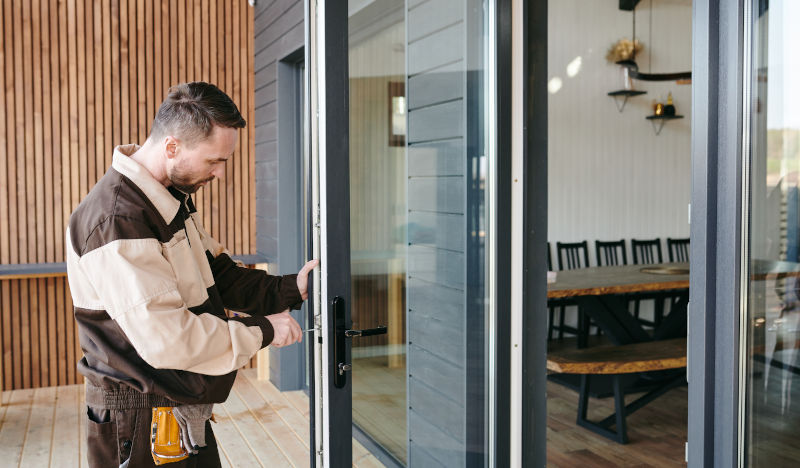
Both sliding and hinged patio doors are low-maintenance products when they're properly specified and installed. The maintenance tasks are different, but neither is particularly demanding.
Sliding door maintenance
The main maintenance task for sliding doors is the track. Dirt, debris, leaves, and dust collect in the floor track channel and can interfere with smooth operation over time. Cleaning the track with a brush and vacuum, followed by a wipe-down, is enough to keep the door sliding freely. Avoid using oil-based lubricants on the track, as they attract and hold dirt. A dry silicone spray is the appropriate choice for the track and rollers.
The rollers themselves are the mechanical component most likely to need attention over the door's life. Quality doors use adjustable rollers that can be fine-tuned without removing the panel. If the door begins to drag or sits unevenly in the frame, the rollers can usually be adjusted with a screwdriver through an access hole in the frame.
Hinged door maintenance
Hinges are the primary maintenance points on a hinged patio door. Over time, hinge pins can wear, screws can loosen, and the door may begin to sag or drag on the threshold. Regular inspection of hinge tightness and occasional lubrication keep this in check.
Weatherstripping on hinged doors compresses against the frame each time the door closes. It performs well initially, but wears faster than the brush seals on quality sliding doors. Checking the weatherstripping annually and replacing it when it shows signs of compression or cracking helps maintain the door's energy performance.
General maintenance for both types
Regardless of door style, these tasks apply to all patio doors:
- Clean glass panels with a standard glass cleaner to remove mineral deposits and grime
- Inspect the frame for cracks, gaps, or paint failure annually
- Check seals around the perimeter for air infiltration, particularly after the first winter season
- Lubricate locking mechanisms with a graphite or dry-spray lubricant
- Inspect and clean screen panels in spring
| Task | Sliding door | Hinged door | Frequency |
|---|---|---|---|
| Track cleaning | Required — brush and vacuum | Not applicable | Monthly in high-use seasons |
| Roller inspection | Check and adjust as needed | Not applicable | Annual |
| Hinge tightening | Not applicable | Required — check for sag | Annual |
| Weatherstripping | Brush seals, check for wear | Compression strip, check for deformation | Annual (before winter) |
| Lock lubrication | Dry spray or graphite | Dry spray or graphite | Annual |
| Glass cleaning | Standard glass cleaner | Standard glass cleaner | As needed |
| Screen cleaning | Remove and rinse | Remove and rinse | Spring and fall |
How much do patio door options usually cost in Canada?
Cost depends on several variables working together: the door size, the glass package, the frame specification, the complexity of the installation, and any customization in colour or finish.
Canadian Choice Windows & Doors provides a general Canadian patio door range of $1,500 to $5,000 or more as a useful starting point for budgeting. Within that range, the variables that move the number up or down are:
- Door size: Larger panels require more material and stronger structural support. A 1.8 m sliding door will cost less than a 2.4 m or 3.0 m unit.
- Glass package: Double-pane Low-E with argon is the standard. Triple-pane adds cost but improves performance in colder climates. Between-glass blinds or decorative glazing options also affect price.
- Frame and finish: Standard white vinyl is the baseline. Woodgrain foil wraps, custom colours, or interior/exterior colour matching add to the cost.
- Installation complexity: A straightforward replacement of a same-size opening is less expensive than a new opening or a structural modification to change the opening size.
- Hardware and accessories: Upgraded locking systems, screen door options, threshold covers, and architectural hardware all affect the final price.
Installation labour in Canada varies by region and project complexity. Urban centres generally carry higher labour rates. Structural modifications, second-floor access, or new rough openings increase the overall project cost.
For most mid-range sliding patio door installations in Canada, homeowners can expect to spend between $2,000 and $3,500 installed, depending on the province and the specific product specification.
| Door type and specification | Approximate installed cost range |
|---|---|
| Basic sliding patio door, double-pane, standard white | $1,500 to $2,500 |
| Mid-range sliding patio door, Low-E, argon, custom colour | $2,500 to $3,500 |
| Premium sliding patio door, triple-pane, woodgrain finish | $3,500 to $5,000+ |
| Standard French door pair, double-pane | $2,000 to $3,500 |
| Premium French door pair, triple-pane, custom hardware | $4,000 to $6,000+ |
Which door should homeowners choose for different room layouts?
Every room type presents its own layout constraints, and the right door for a compact condo is not necessarily the right door for a detached home with a large patio.
Best for tight rooms
Condos, townhomes, compact apartments, and any room with limited square footage should default to sliding patio doors. There is no practical alternative that preserves as much usable floor space. The combination of no swing clearance and maximum glass area makes sliding doors the standard choice for these situations, and it's why they're the dominant product in Canadian multi-unit residential construction.
Best for traditional homes
Detached homes with heritage architecture, larger floor plates, and traditional exterior detailing are where French or hinged doors genuinely earn their place. The visual weight of panel-and-rail construction, visible hinge hardware, and the ceremonial quality of two doors swinging open together suit a home that is built to that scale and style. In these settings, the clearance requirement is manageable, and the aesthetic payoff is real.
Best for entertaining
For homeowners who use the patio as a primary entertaining space during warmer months, the key question is whether a full-width opening is needed. If furniture, catering equipment, or large groups of people need to move freely between indoors and outdoors, French doors with their full opening width have a clear advantage. If the patio access point is more of a doorway than a full opening, a sliding door is simpler and more frequently used.
| Room type | Recommended door | Reason |
|---|---|---|
| Condo balcony access | Sliding patio door | No floor space to sacrifice for swing clearance |
| Kitchen walkout, compact | Sliding patio door | The door stays out of the traffic path when open |
| Dining room, small to medium | Sliding patio door | Table placement unrestricted |
| Living room, large detached home | Either, depending on style | If space allows, French doors add visual impact |
| Basement walkout | Sliding patio door | Tight stairwell areas conflict with swing |
| Formal entertaining room, large home | French/hinged doors | Full-width opening suits the entertaining scale |
| Bedroom balcony, condo or townhome | Sliding patio door | Minimal footprint in the sleeping area |
| Traditional home, heritage exterior | French/hinged doors | Exterior aesthetic matches architecture |
What is the final verdict on sliding door vs hinged door space savings?
Sliding patio doors save more interior space than French doors in most Canadian homes. The reason is simple: no swing clearance. A sliding door uses zero floor area beyond its own frame line, which means every square metre of the room remains usable regardless of how close furniture is placed to the patio wall.
Hinged doors, including French door pairs, require clear swing space equal to the door width on whichever side they swing. In small rooms, condos, townhomes, and compact layouts, that clearance is floor space that can't serve any other purpose. In larger homes with generous room proportions, the trade-off is manageable — and in those settings, the aesthetic and practical benefits of a full-width hinged opening become genuinely valuable.
The practical decision framework comes down to three questions:
- How much clear floor space does the room have in front of the door wall?
- Is the full-width opening a priority, or is a half-width sliding opening sufficient?
- Does the exterior design of the home suit a traditional hinged door, or is a contemporary sliding door a better fit?
For most Canadian homes — especially those in urban and suburban markets where space efficiency is a real consideration — sliding patio doors provide better daily functionality, improved traffic flow, and greater furniture flexibility. When the room can absorb the swing arc and the full opening width is genuinely useful, a hinged door is a strong option.
Frequently Asked Questions
Do sliding patio doors really save more space than French doors?
Yes. A sliding patio door moves horizontally within its own frame, so it does not require any swing clearance. French or hinged doors require 0.8–1.2 metres of clear floor space for the swing arc, which limits furniture placement and traffic flow.
Are sliding patio doors a good choice for condos and small rooms?
Absolutely. Sliding doors are one of the best options for condos, compact dining rooms, basement walkouts, and narrow kitchens because they preserve every square metre of usable floor space. This is why they are commonly used in Canadian condo construction.
Do French doors provide a wider opening than sliding doors?
Yes. French doors can open to nearly the full width of the frame because both panels swing open. A sliding patio door typically opens to about half of the total frame width since one panel remains fixed.
Which patio door style is better for entertaining?
It depends on the layout and how the space is used. French doors work well in large homes where homeowners want a dramatic full-width opening for gatherings and indoor-outdoor entertaining. Sliding doors are often more practical for everyday use because they create smoother traffic flow and stay out of the walkway.
Are sliding patio doors energy efficient in Canadian winters?
Yes — when properly specified and professionally installed. Modern sliding patio doors with insulated vinyl frames, Low-E glass coatings, argon gas fill, and ENERGY STAR-certified glazing systems can perform very well in Canadian climates.
Which patio door style is easier to maintain?
Both options are relatively low maintenance, but the maintenance tasks differ. Sliding doors mainly require occasional track cleaning and roller adjustment, while hinged doors require hinge inspection and weatherstripping maintenance.
Are sliding patio doors secure?
Yes. Modern sliding patio doors can be highly secure when equipped with multi-point locking systems, anti-lift protection, reinforced frames, and tempered or laminated safety glass. Professional installation also plays a major role in overall security performance.

1000’s of Colours & Textured Finishes
Transform your home from ordinary to extraordinary with our new coloured and non-glare textured finishes. Available in a wide array of colours as well as custom matched colours for your very own personalized design.
Our Most Popular Replacement Window Colours: