Why Buying Canadian-Made Windows Is Better for Your Home (and Your Budget)


Buying Canadian-made windows is better for your home and your budget because products built here are engineered for Canadian winters, rated on a Canadian performance scale, backed by local warranty service, and built to fit the openings you actually have.
Those four advantages come from how the product is specified and supported, not from the country name on the sticker. A window built for a heating-dominated climate carries different glazing, gas fills, spacers, and frame reinforcement than a unit designed for a mild market. Origin alone still guarantees nothing, because the certified numbers on the label and the quality of the window installation decide how the window behaves once it is in your wall. This guide covers what to compare, how to check an origin claim, and where local manufacturing genuinely changes what you live with for the next 20 years.
Key Takeaways
- Certified ratings on the label carry more weight in a buying decision than the country named on the box.
- Natural Resources Canada reports that ENERGY STAR-certified windows are about 20 percent more energy-efficient than the average window.
- Canadian energy performance is tested to the CSA A440.2 standard and reported as U-factor, solar heat gain coefficient, and Energy Rating.
- The Competition Bureau treats “Made in Canada” and “Product of Canada” as separate claims with different Canadian content thresholds.
- Local manufacturing usually simplifies warranty service, replacement parts, and custom sizing, but each of those should be confirmed in writing.
- Vinyl frames suit Canadian conditions because they insulate well, resist moisture, and need very little upkeep.
- Installation quality determines whether a well-rated window delivers the performance it was built for.
Why are Canadian-made windows a better fit for Canadian homes?
Windows built in Canada are designed for the conditions they will actually face, which is why they suit Canadian homes so well.
Climate sets the specification. Most of the country spends far more of the year heating than cooling, so a window designed for this market is built around low heat loss, strong edge performance, and tight air sealing rather than aggressive solar control. Manufacturers building for Canada also work within the Canadian rating system, which reports an Energy Rating that combines heat loss, solar heat gain, and air leakage into a single number. That shared scale is what lets you hold two quotes side by side and compare them on a real basis. It also means the products you are shown were measured under conditions your home experiences, rather than against a milder benchmark.
Fit is the second reason, and it matters more than most homeowners expect. Canadian housing stock is varied, and older homes rarely have openings that match standard sizes, so building to measure is routine here rather than a premium extra. A domestic plant can produce the exact dimensions for your home, along with the frame colours, grille patterns, and hardware finishes you selected. A shorter transport distance also removes several handling stages during which a custom unit can be delayed or damaged. Canadian Choice Windows & Doors™ has been building and installing on that basis for more than 30 years, and the pattern holds across the industry: local production tends to remove friction rather than add performance.
It is worth being straight about the limits of the argument. A poorly specified window built in Canada will underperform a well-specified one built elsewhere, because physics does not read labels. What origin reliably affects is the ownership side of the purchase: service access, parts, customization, and the ability to reach someone accountable for the product. Treat a Canadian-made claim as a reason to look closer, then judge the window on its ratings, its construction, and the crew installing it.

What does Canadian-made actually mean?
In everyday marketing, Canadian-made usually means the finished unit was assembled at a plant in Canada, while components such as glass, hardware, or frame profile may come from more than one country. That is normal in the window industry and is not a problem in itself, since global sourcing of components sits behind most manufactured goods. What matters is that the phrase carries a specific legal meaning, and that meaning is narrower than the impression a maple leaf on a brochure creates. A later section explains how the Competition Bureau distinguishes between the two common claims and what to ask to verify the answer.
How do windows made in Canada perform during cold winters and major temperature swings?
Cold-climate performance comes from several measurable components working as one system, not from any single feature.
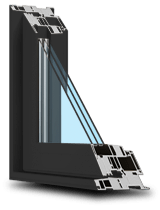
The insulated glass unit does the heaviest lifting. Two or three panes are sealed with an insulating cavity between them, and that cavity is normally filled with an inert gas such as argon, which slows heat transfer more effectively than air. A Low-E coating is a microscopically thin metallic layer that reflects heat back toward its source, helping keep warmth inside during a long heating season. Around the perimeter, a warm-edge spacer limits heat loss at the glass edge and allows the unit to accommodate the expansion and contraction caused by temperature swings. Together, these parts raise the glass's interior surface temperature, which is what you actually feel when you sit beside a window in February.
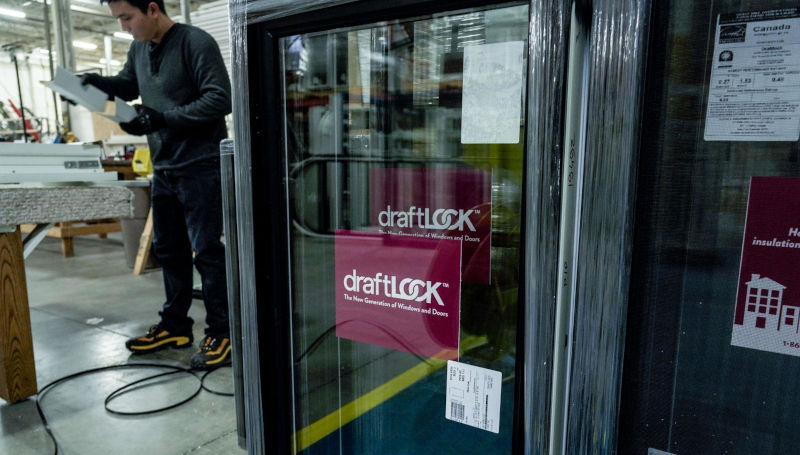
The frame and the seals decide how long that performance lasts. Multi-chamber frames trap still air within the profile, and internal reinforcement keeps larger units square as materials expand and contract with temperature. Weatherstripping and compression hardware pull the sash tight against the frame so air leakage stays low through years of daily use, which is the goal behind sealing systems such as DraftLOCK , developed by Canadian Choice Windows & Doors™ to keep the sash pressed against its seals season after season. DraftLOCK combines triple-sealed, welded frames, internal thermal insulators, and reinforced frames fitted with premium stainless steel hardware, keeping the moving parts and the weather seal working together long after installation. The assembly then has to be shimmed, insulated, and sealed correctly in the rough opening, because air that travels around a window never passes through the tested assembly.
Regional conditions change what the same window has to cope with, which is one reason a domestic manufacturer builds different configurations for different provinces. On the coast, a Vancouver home faces persistent rain and high humidity through most of the winter, so drainage detailing, corrosion-resistant hardware, and condensation control matter as much as raw cold-weather ratings, and anyone comparing a window installer in Vancouver should ask how the unit sheds water rather than only how it holds heat. In Alberta, a Chinook can raise temperatures by 10 degrees or more within a few hours, so a Calgary window company should be able to explain how its frames and seals handle repeated expansion and contraction. On the Atlantic side, a window installer in Halifax contends with wind-driven rain and salt-laden air, which emphasizes watertightness and corrosion-resistant hardware. Labour rates, site access, and seasonal demand also differ across these markets, so two quotes for the same product can land at different prices without either being unreasonable.
Why airtightness matters
Air leakage is the quiet variable in window performance, because it stays invisible until you feel it. A unit with an excellent glass package can still feel cold and cost money to run if air moves through the sash seal or around the frame. Tested air leakage values are listed in the certification documentation, and lower numbers indicate a tighter unit under identical test conditions. Ask for that value alongside the U-factor, and ask separately how the crew will insulate and seal the perimeter, since the two together decide what the window does in your house rather than in a laboratory.
Can Canadian-made windows help lower your heating and cooling costs?
They reduce the energy your home loses through its openings, though how much that changes your bill depends on the house rather than the label.
The scale of the opportunity is documented. Natural Resources Canada reports that windows, doors and skylights can account for up to 25 percent of a home’s energy loss, and that ENERGY STAR certified windows are about 20 percent more energy efficient than an average window. Models carrying the ENERGY STAR Most Efficient designation sit higher again, which NRCan describes as up to 55 percent more efficient than average products. Those figures describe the window under a standardized test, not your utility account, and the distinction matters when you are reading a quote. They tell you how much better a certified unit performs, and that improvement then translates to everything else in your home.
Your result depends on what you are replacing and what surrounds it. A home with single-pane or failed double-pane units will see a far larger change than one replacing windows that already performed reasonably well. Wall insulation, air sealing elsewhere in the envelope, heating fuel and local rates, orientation, and how many openings you replace at once all move the outcome. Comfort usually arrives before savings show up on paper, because warmer glass and fewer drafts change how a room feels within a day. Planning around comfort, durability, and reduced heat loss is more honest than planning around a promised dollar figure.
Efficiency ratings versus dollar savings
Efficiency is a property of the product, measured under controlled conditions and printed on a label. Savings are a property of your household, produced by that product interacting with your building, your habits, and your energy prices. Anyone promising a precise percentage off your bill is describing something they have not measured, since no one has audited your envelope or your consumption. A more useful conversation compares certified ratings across quotes, identifies the openings that lose the most heat, and treats new energy-efficient windows as part of a broader envelope plan rather than a standalone fix.
“The conversation I like having with a homeowner starts with the rating sheet, not the brochure. Once we walk through the U-factor, the Energy Rating, and the air leakage numbers together, people stop comparing prices in the dark and start comparing windows that will behave the same way in their home. That is usually the moment the decision gets easier.” Helen Sin, Consumer Success Manager at Canadian Choice Windows & Doors™
Which energy-efficiency ratings should homeowners compare before choosing new windows?
Four values carry most of the weight in Canada: U-factor, solar heat gain coefficient, Energy Rating, and air leakage.
These are not marketing terms and are produced using a defined method. In Canada, the energy performance of windows, doors and skylights is tested using the Canadian Standards Association A440.2 standard , with results verified by an accredited certification body rather than by the manufacturer alone. That is what makes numbers comparable between brands. When two quotes list the same certified values, you are looking at products that behaved the same way under the same test, and when one quote lists ratings while the other lists adjectives, you are not comparing anything at all.
U-factor describes the rate of heat transfer through the whole assembly, so a lower number means less heat escaping. Solar heat gain coefficient describes how much of the sun’s heat passes through the glass, where a higher number captures more free warmth in winter and more unwanted heat in July. Energy Rating combines heat loss, solar gain, and air leakage into a single figure, with higher values indicating better performance, which is why it performs well in a heating-dominated climate. Air leakage is reported separately and indicates how tightly the unit closes when locked. Reading them together prevents the common error of chasing one value while quietly losing ground on another.
Knowing what each value means is only half the job. The table below sets out what a cold-climate buyer should be watching for on each line, and the mistake that most often costs homeowners performance they paid for.
| Rating | What to watch for in a Canadian climate | Common mistake |
|---|---|---|
| U-factor | Lower values, compared across the same window size and configuration | Comparing a centre-of-glass figure against a whole-window figure |
| Energy Rating (ER) | Higher values, useful as a single balanced number for cold regions | Assuming two certified products are equal when they qualified by different routes |
| Solar heat gain coefficient (SHGC) | A value matched to each elevation rather than one figure for the house | Applying a high-gain package to south and west walls with large glass areas |
| Air leakage | Lower values, requested in writing alongside the U-factor | Leaving it out of the comparison because it rarely appears in sales material |
| Visible transmittance (VT) | Higher values in rooms where daylight is the point | Trading away daylight for a marginal thermal gain in a dark room |
One detail is worth carrying into every showroom conversation. An ENERGY STAR-certified window qualifies based on either its U-factor or its Energy Rating, so two certified products can earn the same badge by different routes. Ask which value the certification applies to, and confirm that the numbers match the exact model, size, and glass package in your quote, since performance can vary across configurations within a single product line.
How do Canadian-made windows compare with imported windows on performance and lifetime value?
On performance, the comparison should be made rating by rating, while the practical differences usually appear after the sale rather than before it.
Certified values travel with the product regardless of where it was built, which keeps the performance question simple. An imported window with strong ratings will perform in line with those ratings, and a domestic window with weak ratings will not improve because of its postcode. Where origin starts to matter is in how products are configured for this market, since units built for Canadian distribution are typically specified for cold-weather duty as standard, while imported inventory may arrive in configurations designed for a different climate. Ask for the certified numbers on the exact configuration you are buying, and most of the geography argument resolves itself.
Lifetime value is where the gap tends to widen. A window is something you live with for decades, and during that time you may need a replacement sealed unit, a balance, a lock, or a screen. Parts availability, warranty administration, and service territory all depend on who stands behind the product and how far away they are. Shipping distance affects the turnaround on those parts, which is the difference between a repair scheduled next week and one scheduled next season. None of this is guaranteed by origin, but all of it is far easier to verify when the manufacturer operates in your market.
Upfront price versus total ownership cost
The lowest quote is not the only option when both proposals include the same items. Differences in glass package, frame reinforcement, hardware grade, installation method, and warranty coverage can substantially affect the price without ever appearing on a summary line. Across a 20-year ownership period, one service call handled promptly under warranty can be worth more than a modest saving at purchase. Comparing replacement window costs between suppliers is only useful after you have normalized the specifications, so the number in front of you reflects the same product rather than a different one.
Does buying locally manufactured windows make warranty service and replacement parts easier?
It usually does, because the people who built the product work in the same market as the home, though this should be verified rather than assumed.
Warranty value depends less on the length of the term than on how a claim is handled in practice. A domestic manufacturer can normally process a claim without an international intermediary, and a local dealer network can inspect the unit and order the component through a familiar channel. Replacement parts follow the same logic, since hardware, balances, and sealed units built for this market are more likely to be stocked here. Service territory belongs in the same conversation, because a warranty is only convenient when someone covers your address, and whether you are dealing with a window company in Toronto, a window installer in Halifax, or a window company in British Columbia, the question stays the same: who performs the work, and where.
The honest caveat is that none of this is automatic. Some imported products are supported by excellent domestic distributors, and some domestic products carry warranties with exclusions that quietly reduce their value. What settles it is the paperwork, so ask for the warranty document before you sign, read the exclusions rather than the headline term, and confirm whether labour is covered on a service visit or only the part itself. Ask as well whether coverage transfers if you sell the home, since a transferable warranty is worth something at resale.
How can you verify whether windows made in Canada are genuinely Canadian-made?
Read the exact wording of the claim, then ask where the unit was assembled and where its major components came from.
The two common phrases are regulated, and they do not mean the same thing. Competition Bureau guidance states that a Made in Canada claim is generally acceptable when at least 51 percent of the total direct costs of producing or manufacturing the goods were incurred in Canada, the last substantial transformation happened in Canada, and the claim carries a qualifying statement such as “Made in Canada with imported parts.” A Product of Canada claim is held to a higher standard, requiring that at least 98 percent of those direct costs be incurred in Canada, along with the same substantial transformation test. The Bureau also notes that it does not approve or certify these claims, so accuracy rests with the seller. That single distinction explains how two companies can both sound Canadian while describing very different supply chains.
Applied to windows, this is less dramatic than it sounds. Fenestration relies on a global supply chain, and glass, hardware, and profile are commonly sourced from multiple countries, even when the finished unit is fabricated here. What matters to a homeowner is transparency rather than purity: a manufacturer who can name the plant, describe which stages occur there, and explain where the major components originate is giving you something verifiable. A supplier who answers with flags and slogans is giving you decoration. Neither answer disqualifies a company on its own, but only one of them can be verified.
Made in Canada versus Product of Canada
The practical reading is that Made in Canada signals substantial domestic manufacturing with imported content acknowledged, while Product of Canada signals a nearly complete domestic cost base. Phrases such as "Assembled in Canada" or "Designed in Canada" describe narrower activities and should be taken literally rather than generously. When a claim appears without any qualifying statement, it is fair to ask for one. The point is not to catch a supplier out, but to know exactly what you are buying before a deposit changes hands.
Five questions turn that guidance into something you can use on a showroom floor or a kitchen table, and each one has a documented answer if the claim is sound.
- Where is the finished window assembled, and can you name the facility?
- Which origin claim appears on your documentation, and does it carry a qualifying statement?
- Where do the glass, the hardware, and the frame profile come from?
- Which accredited body certified the energy performance of this model?
- Can you send the certification documentation for the exact configuration you quoted?
Should you choose double-pane or triple-pane windows for a Canadian home?
Both perform well in Canada, and the right answer depends on the exposure, the room, and how the rest of the house behaves.
Exposure is usually the deciding factor. Cold north-facing walls, rooms that never quite hold their temperature, bedrooms facing a busy street, and homes in the coldest parts of the country tend to reward a third pane most clearly. Sheltered elevations and rooms where winter sun is genuinely useful often do just as well with a strong double-pane package built around a Low-E coating, an argon fill, and a warm-edge spacer. Many homeowners end up mixing both across a single project rather than committing the whole house to one answer. That approach puts the money where it changes daily comfort, rather than spreading it evenly for the sake of consistency.
The second factor is the remaining balance in your envelope. In a home that is otherwise well-insulated and reasonably airtight, windows become the weakest link, and extra glazing yields a clear return in comfort. In an older home with significant air leakage in the attic and rim joists, the same money often does more good sealing those areas first, then upgrading the glass. Weight belongs in the discussion too, since heavier sashes place greater demand on hardware and installation, particularly for large openings. Your installer should be willing to walk through the house with you and provide a different recommendation for each wall.
The comparison below sets the two configurations against each other on the attributes that actually differ, so you can match them to the walls you have rather than to a general preference.
| Consideration | Double pane with Low-E and argon | Triple pane |
|---|---|---|
| Insulation (U-factor) | Strong performance across most openings | Lower U-factor thanks to a second sealed cavity |
| Interior glass temperature | Comfortable in most rooms | Warmer at the glass, noticeable on cold walls |
| Condensation resistance | Good when indoor humidity is controlled | Higher resistance under the same indoor conditions |
| Sound control | Moderate reduction of outside noise | Better damping, often noticed near traffic |
| Weight and hardware demand | Lighter, easier on hardware and large sashes | Heavier, with more demand on hardware and installation |
| Solar gain and daylight | Slightly higher gain and light transmission | Slightly lower, as each pane absorbs and reflects more |
| Where it fits best | Sheltered walls and rooms with useful winter sun | Cold exposures, noisy streets, and the coldest regions |
When the extra pane earns its place
Triple glazing makes the clearest case when the discomfort is measurable rather than theoretical. A room that stays colder than the rest of the house, frost forming at the edges of the glass during a cold snap, or traffic noise that interrupts sleep are all problems the third pane addresses directly. It also earns its place in homes where the envelope has already been improved, and the windows are now the limiting factor. Where a house still leaks air through the attic hatch and the basement rim, sequencing that work first usually produces a more comfortable home for the same spend.
When does it make financial sense to buy Canadian windows?
The purchase makes sense when your current windows are failing, when you will stay long enough to enjoy the improvement, and when the quotes in front of you describe the same product.
Start by breaking the project into parts rather than treating it as a single number. The units, the glass package, the installation labour, disposal of the old windows, interior and exterior finishing, and any sill or structural repair each contribute to the total. Financing costs belong in the calculation if you are spreading payments, and so does the expected service life of what you are buying. Reviewing typical replacement window cost ranges before you collect quotes simply makes the proposals feel familiar rather than surprising.
Timing carries as much weight as arithmetic. If windows are fogged, drafty, seized, or letting in water, the decision has already been made for you, because waiting results in discomfort, risk of damage, and increased heating load. If the existing windows are dated but sound, there is room to plan, gather quotes, and book the work for a season that suits you. Your ownership horizon belongs in the decision, too, since a homeowner staying for 15 years weighs durability and warranty differently than one selling within 2. Rebates and financing programs can also change the picture, as eligibility and funding change periodically; confirm any program directly with its administrator when you buy.
Quotes only become comparable when they describe the same scope, and the items below are the ones most often left off a page. Ask for each in writing before you sign anything.
- Itemized pricing for the units, the glass package, and the installation labour.
- The exact model, configuration, and certified performance values for each opening.
- The installation method, including how the perimeter will be insulated and sealed.
- Removal and disposal of the existing windows.
- Interior and exterior finishing, and who is responsible for it.
- Warranty terms for the product and for the workmanship, listed separately.
- Production and installation dates, with the process for handling a delay.
How can local manufacturing affect lead times, customization, and project planning?
Local production shortens the distance between a measurement and a finished unit, and that usually shows up as flexibility rather than raw speed.
Customization is the clearest gain. Because domestic plants built to order for a market full of non-standard openings, custom dimensions, frame colours, grille patterns, and hardware finishes are routine rather than exceptional. That flexibility matters when you are matching existing trim, working within a heritage requirement, or fitting an opening that has shifted over several decades. It also makes it practical to choose different window styles for different rooms in one order, so a casement can go where ventilation matters and a fixed unit where the view does. Fewer shipping stages also means fewer opportunities for a custom unit to arrive late or damaged.
Lead times deserve a more careful claim than most advertising gives them. Domestic manufacturing removes ocean freight and customs from the schedule, but production capacity, seasonal demand, glass supply, and crew availability all still apply. Spring and summer are busy across the industry, and a custom order placed in peak season will not move faster simply because the plant is nearby. The dependable approach is to ask for the production window and the installation date in writing, then plan around those dates rather than around a general impression.
“When the plant is close, we can build the schedule around the house instead of around a shipping container. We measure, confirm the sizes and finishes, and give the homeowner dates they can hold us to. I would rather commit to a realistic date in writing and meet it than promise a fast one and renegotiate later.” Tony Wong, Project Manager at Canadian Choice Windows & Doors™
Which window features matter most for comfort, durability, and long-term value?
Separate what can be measured from what is merely described, and let the measured items carry the decision.
The measurable group includes the certified U-factor, the Energy Rating, the solar heat gain coefficient, and the tested air leakage, all measured under standardized testing conditions. Certification is measurable too, since ENERGY STAR recognition depends on defined thresholds rather than opinion, and NRCan sets its Most Efficient criteria for windows at a U-factor of 1.05 W/m²K or lower, or an Energy Rating of 40 or higher. Construction details belong in the same group, including coating type, gas fill, spacer design, frame chambers, reinforcement, and hardware grade, because each can be confirmed in documentation. Frame material sits here as well, and vinyl continues to suit Canadian conditions because multi-chamber vinyl windows insulate well, resist moisture, and ask very little in maintenance over their service life.
The descriptive group is everything a brochure can say without proof. Words like premium, advanced, or superior cannot be compared between companies and should carry no weight in a decision. That does not make them dishonest, only unusable. When a feature genuinely matters, ask what it is measured by and request the documentation, and anything that survives that question belongs in your comparison.
Product quality versus installation quality
A high-performing window sitting in a poorly sealed opening will not deliver its rated performance, because air moving around the frame never passes through the tested assembly. Accurate measurement, proper shimming, full-perimeter insulation, and appropriate sealants are what turn a specification into a result you can feel. Sealants and foams also have application conditions, which is why experienced crews plan the work around the weather rather than pushing through. When comparing two similar prices, compare the installation scope as closely as the product itself, because that is usually where the difference lies.
How should you choose a Canadian window manufacturer and installer?
Choose documentation over impressions, and favour the company that answers specific questions with specific evidence.
Start with proof of manufacturing location and independent certification, then move to the numbers for the exact products being quoted. Ask for a written scope of work that specifies the installation method, the sealing approach, and the included finishes, since these three items separate most proposals. Confirm the service area as well, because a warranty that covers your product but not your address helps no one, and homeowners searching for a window company near me are often comparing businesses with very different coverage maps. Reliable window installation services will put all of this on paper without being pushed.
Consistency through the process is the signal worth watching. The company that measures carefully, quotes in detail, explains trade-offs plainly, and commits to dates in writing is usually the same company that answers the phone when a balance fails in year eight. Reputation helps, but specificity helps more, because specificity can be checked. Comparing two or three complete proposals rather than three headline numbers costs an extra week and regularly saves far more than that.
Before installation day, a short document check protects you from the problems that are hardest to fix afterwards. Each item below should exist on paper rather than in conversation.
- Certification documentation for the energy performance of each model quoted.
- The full written warranty, including exclusions and labour coverage.
- An itemized quote covering the complete scope of work and finishing.
- Proof of liability insurance and applicable workers’ coverage.
- Confirmed production and installation dates, with a written process for changes.
What should you remember before investing in Canadian-made windows?
Buying Canadian-made windows works in your favour when you treat origin as the starting point and specifications as the decision-making factor. Products built for this market are typically configured for cold-weather duty, tested to the CSA A440.2 standard, and reported using U-factor, solar heat gain coefficient, and Energy Rating values that you can compare directly between quotes. Local manufacturing then adds what shows up over decades of ownership: sizing built to your openings, warranty administration you can reach, replacement parts that do not cross an ocean, and a schedule someone will put in writing. Check the origin claim against the wording the Competition Bureau uses, match the glazing package to each exposure rather than applying one answer to the whole house, and give installation quality the same attention as the product, because a well-rated window performs only as well as the opening it sits in.
If you are ready to move from research to a plan, the next useful step is a conversation about your specific openings, climate, and priorities. Canadian Choice Windows & Doors™ works with homeowners across the country on projects that begin with a measurement and end with a written scope, a certified product, and dates you can hold. You can explore the full range of windows and doors and book a no-pressure consultation to see which configuration suits your home, then request a detailed quote outlining the specifications, installation scope, warranty coverage, and total project cost.
Frequently Asked Questions
Are Canadian-made windows always better than imported windows?
Not automatically. Certified performance values travel with the product, so a well-specified imported window performs to its ratings, and a poorly specified domestic one does not improve because of where it was built. What Canadian manufacturing reliably improves is the ownership experience: cold-climate specification as standard, custom sizing, warranty administration, and access to replacement parts.
What is the difference between Made in Canada and Product of Canada?
The Competition Bureau's guidance treats them as separate claims. Made in Canada generally requires that at least 51 percent of total direct manufacturing costs be incurred in Canada, that the last substantial transformation occurs here, and that a qualifying statement about imported content be included. Product of Canada requires at least 98 percent of those direct costs to be incurred in Canada.
How much can new windows reduce my heating bill?
There is no single figure, because the result depends on what you are replacing, your insulation and air sealing, your heating fuel and rates, and how many openings you replace. Natural Resources Canada reports that ENERGY STAR-certified windows are about 20 percent more energy-efficient than the average window, which describes the product rather than your utility account.
Which rating matters most in a cold climate?
U-factor and Energy Rating carry the most weight, since one measures heat loss directly and the other balances heat loss, solar gain, and air leakage in a single number. Read them together with the tested air leakage value, and confirm the numbers apply to the exact configuration in your quote.
Is triple pane glass necessary in Canada?
Not always. A quality double-pane unit with a Low-E coating, argon fill, and a warm-edge spacer performs well in many homes. Triple glazing makes the strongest case on cold exposures, in noisy locations, in the coldest regions, and in homes where the rest of the envelope already performs well.
Are vinyl windows a good choice for Canadian homes?
For many homeowners, yes. Multi-chamber vinyl frames insulate well, resist moisture, handle repeated temperature changes, and need very little maintenance. The right choice still depends on your budget, the look you want, and how long you plan to stay in the home.
How far in advance should I order replacement windows?
Allow several weeks between the final measurement and installation, and more during spring and summer when demand is highest across the industry. Custom sizes and finishes add production time, so ask for the production window and the installation date in writing rather than relying on a general estimate.

1000’s of Colours & Textured Finishes
Transform your home from ordinary to extraordinary with our new coloured and non-glare textured finishes. Available in a wide array of colours as well as custom matched colours for your very own personalized design.
Our Most Popular Replacement Window Colours: