Types of Replacement Windows in Calgary

Choosing between different types of windows is one of the first decisions you face in any Calgary window replacement project, and it has consequences that go well beyond how the window looks. The style you choose affects air leakage, how well the window seals against cold weather, and how easy it is to clean and maintain over the years. This guide covers the main window styles commonly used in Calgary homes, explains how they differ in practical terms, and helps you match the right window type to each room.
Key takeaways
- Window style affects energy performance, airtightness, comfort, and appearance.
- Among operable styles, casement and awning windows usually provide the strongest seal for cold climates, while sliding and hung styles offer practical, budget-conscious alternatives.
- Glazing matters as much as style. Double-pane glass with Low-E coating and argon fill is commonly used in replacement windows, while triple-pane glass can provide stronger insulation for Calgary’s long heating season.
- The right window choice depends on the room, orientation, and daily use, with no single solution working equally well across the entire home.
- Proper installation and matching the window type to the space help reduce heat loss, prevent performance issues, and support long-term comfort.
Why window style matters more than most homeowners think
Many homeowners start their window search by comparing styles and looking for an option that suits the look of their home. That's a reasonable starting point, but style affects more than appearance. The mechanism by which a window opens determines how tightly it seals when closed, which directly affects how much heat stays in your home during a Calgary winter. Natural Resources Canada notes that windows, doors, and skylights can account for up to 35% of a home’s total heat loss. Window style is one of several factors, along with glazing, frame quality, and installation, that can influence performance. The window style you choose is one of the variables you can actually control.
Style also affects ventilation, access for cleaning, and the long-term ease of window maintenance. These are all worth understanding before you commit to a product.
The main types of windows for homes in Calgary

Here is a practical breakdown of each major window style, what it does, and where it tends to work best in a Calgary home.
Casement windows
Casement windows are hinged at the side and swing outward on a crank mechanism. When the window is closed, the sash presses firmly against the frame on all four sides, creating a compression seal. This compression seal is among the strongest available for standard operable window styles, making casement windows a strong choice for cold-climate performance.
The full-perimeter compression seal also helps reduce air infiltration, especially when the window is well-made, properly installed, and maintained over time. They open wide, providing excellent ventilation when needed, and the crank mechanism makes them practical in hard-to-reach locations, such as over a kitchen counter.
Best for: bedrooms, living areas, kitchens, and any location where energy performance is a priority.
Awning windows
Awning windows are hinged at the top and swing outward from the bottom. Like casement windows, they use a compression seal when closed and perform well in terms of airtightness. The key practical advantage of awning windows is that they can remain partially open during light rain without allowing water into the home.
This makes awning windows a common choice for bathrooms and kitchens, where you want ventilation without being fully exposed to the weather. They are also frequently paired with fixed picture windows as a combination unit, where the picture window provides the view, and the awning section provides the ventilation.
Best for: bathrooms, kitchens, basement utility rooms, and combination installations with picture windows.
Single hung windows
Single-hung windows have two sashes, one above the other, with only the bottom sash operable. The top sash is fixed. The bottom sash slides upward to allow ventilation. Many single-hung windows include a tilt-in feature that allows the sash to angle inward for cleaning from inside the home.
Single-hung windows are a straightforward option for homeowners who want reliable ventilation while managing the overall project budget. They are a practical choice for rooms where budget is a consideration and where the fixed top sash is not a limitation.
Best for: bathrooms, secondary bedrooms, and projects where cost efficiency is important.
Double hung windows
Double-hung windows look nearly identical to single-hung windows from the outside, but both sashes are operable. The top sash can be lowered and the bottom sash raised, allowing for more flexible ventilation. Lowering the top sash lets warm air near the ceiling escape while keeping the lower portion of the window closed, which is a useful feature in rooms that accumulate heat.
Double-hung windows are widely used in residential construction and replacement projects. Like single hung windows, most include a tilt-in feature for interior cleaning. They work well in traditional-style homes where the window's visual symmetry is part of the overall design.
Best for: bedrooms, traditional-style homes, and any space where top-and-bottom ventilation control is useful.
Sliding windows
Sliding windows have one or more sashes that move horizontally along a track. They are mechanically simple, with fewer moving parts than crank-operated styles. This simplicity makes them durable and easy to operate. Some sliding window designs include removable or tilt-in sashes to make cleaning easier, depending on the product.
The trade-off with sliding windows is airtightness. Because the sash moves along a track rather than pressing against a frame, the seal relies on weatherstripping along the sliding edges rather than on full-perimeter compression. This makes sliding windows somewhat less airtight than casement or awning styles, which is worth accounting for in rooms where thermal performance is a priority.
Best for: basements, utility rooms, garages, and spaces where simplicity and low cost matter more than maximum insulation performance.
Picture windows
Picture windows are fixed, meaning they do not open. They are designed to frame a view and bring maximum natural light into a space. Because there is no operable mechanism, picture windows are typically the most airtight of all window types. There are no moving parts or operable sash seals to wear from regular use, although the sealed glass unit and installation perimeter still need to perform properly over time.
The limitation, of course, is that a picture window provides no ventilation. For this reason, they are almost always installed alongside operable windows, either as part of a combination unit or as part of a multi-window arrangement in the same room.
Best for: living rooms, statement walls, spaces with strong views, and combination installations with casement or awning windows.
Bay and bow windows
Bay and bow windows project outward from the exterior wall of the home. A bay window consists of three sections: a large central fixed or picture panel flanked by two angled operable sashes. A bow window uses four or more sections arranged in a gentle curve. Both styles add visual depth to a room from the inside and create architectural interest on the home's exterior.
Because they project beyond the wall plane, bay and bow windows can create additional interior space, often used as a window seat, display ledge, or brighter seating area, depending on the design. The operable side sashes provide ventilation. These windows are more complex to install than standard flat-wall windows and require careful attention to weatherproofing at the projection joints.
Best for: living rooms, dining rooms, and front-facing rooms where the architectural impact is a design goal.
Basement windows
Basement windows serve a different set of priorities from above-grade windows. The primary requirements are structural durability, moisture resistance, and, in many cases, compliance with egress requirements if the basement is a habitable space. Basement windows are typically smaller in size and designed to limit exposure to the below-grade environment while still admitting light.
In Calgary, basement bedrooms typically need windows that meet egress requirements under Alberta building rules, including minimum clear opening requirements. If you are converting or renovating a basement suite, confirm the exact requirements before ordering new windows. If you are converting or renovating a basement suite, confirming whether your existing windows meet egress requirements is one of the first things to address.
Best for: below-grade spaces, utility areas, and basement bedrooms requiring egress compliance.
Different window styles compared: ventilation, light, and energy performance
The table below compares common window styles and applications across the factors that matter most in Calgary homes: ventilation, natural light, airtightness, and room fit. Basement windows are included as an application rather than a single style, since their performance depends on the window type, size, placement, and installation quality.
| Window style/application | Ventilation | Natural light | Airtightness | Best suited for |
|---|---|---|---|---|
| Casement | Excellent | Good | High | Bedrooms, living areas, kitchens, and spaces where cold-weather performance is a priority |
| Awning | Good | Moderate | High | Bathrooms, kitchens, basement utility rooms, and areas needing ventilation during light rain |
| Double hung | Good | Good | Moderate | Bedrooms, traditional-style homes, and spaces where top-and-bottom ventilation is useful |
| Single hung | Moderate | Good | Moderate | Secondary bedrooms, bathrooms, and budget-conscious replacement projects |
| Sliding | Moderate | Good | Lower to moderate | Basements, utility rooms, garages, and wider horizontal openings where simplicity matters |
| Picture / fixed | None | Excellent | High | Living rooms, statement walls, larger views, and combinations with operable windows |
| Bay/bow | Good, depending on operable sections | Excellent | Moderate, depending on configuration and installation | Living rooms, dining rooms, and front-facing rooms where added light and architectural interest are priorities |
| Basement/egress applications | Limited to good, depending on the selected style | Limited to good, depending on size and placement | Varies by selected window style and installation quality | Below-grade spaces, basement bedrooms, and areas where egress requirements may apply |
Note: Airtightness depends on more than style. Glazing package, frame quality, weatherstripping, installation method, and the condition of the surrounding opening all affect long-term performance.
"When we assess a home for window replacement, one of the first things we look at is whether the existing styles are suited to the rooms they’re in. A sliding window in a bedroom may still operate properly, but if comfort and cold-weather performance are priorities, a casement window may provide a tighter seal and a noticeable improvement through a Calgary winter."
Helen Sin, Consumer Success Manager at Canadian Choice Windows & Doors
Single, double, and triple-pane glass: what's the difference
Window style determines how a window opens and seals. Glazing determines how well it insulates. For Calgary homes, the choice of glazing is one of the most consequential decisions in a window replacement project.
Single-pane glass offers very limited thermal resistance compared with modern double- or triple-pane windows. It was standard in homes built before the 1970s and is still found in some older properties in Calgary. In Calgary’s climate, single-pane windows are generally a poor fit for heated living spaces because they allow more heat loss and are more prone to condensation.
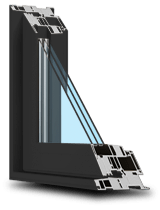
Double-pane glass consists of two panes of glass with a sealed air or gas-filled space between them. Double-pane glass is the common baseline for modern window replacement projects across Canada. Most double-pane units include argon gas fill, which reduces heat transfer through the gap more effectively than air alone. Low-E coatings, which are thin metallic layers applied to the glass surface, can be added to double-pane units to further reduce heat loss.
Triple-pane glass adds a third pane and a second sealed cavity. This provides measurably better insulation than double-pane windows, which is particularly relevant for windows facing north or east in Calgary, where solar gain is limited, and the window is primarily a source of heat loss rather than heat gain. Triple-pane units are heavier and more expensive than double-pane units, but in a Calgary home with a long heating season, they can improve comfort and may reduce heating costs over time, especially when replacing older or poorly performing windows.
How to match different window types to rooms in your Calgary home
There is no single correct answer for every room. The right window style depends on the function of the space, its orientation, and how you use it day to day. Here is a practical guide by room type.
- Living room: A picture window or large casement facing south can help bring in winter sunlight, while west-facing windows may need the right glazing package to manage afternoon heat and glare. A fixed picture panel with operable casement or awning sashes can provide both natural light and ventilation control. A combination of a fixed picture panel with operable casement or awning sashes on either side gives you both maximum light and ventilation control.
- Master bedroom: Casement windows are a strong choice here. The compression seal keeps the room quieter and warmer than a sliding window of equivalent size, and the crank operation is straightforward to use from beside the bed.
- Secondary bedrooms: Single or double hung windows are practical and cost-effective. Double-hung provides more ventilation flexibility; single-hung is the simpler option if the budget needs to be managed across a larger project.
- Kitchen: Awning windows are well-suited to kitchens, especially where you want ventilation during light rain or need a shorter window above a counter. Casement windows can also work well over a sink because the crank operation is easy to use from a working position. An awning window can be left open during light rain and is easy to operate from a working position.
- Bathroom: Awning or single-hung windows work well in bathrooms. The priority here is ventilation and privacy. A small awning window set high on the wall allows air circulation without compromising privacy.
- Basement: Slider windows are common in basement installations, particularly in utility or storage areas. For basement bedrooms, egress-compliant windows are required under the Alberta Building Code, and the specific size requirements should be confirmed before ordering.
"Matching the right window style to the room is something we talk through with every homeowner we work with. It's not just about what looks good in the brochure. It's about how the room is used, which direction it faces, and the homeowner's priorities for comfort and efficiency. Getting that right from the start avoids a lot of regret later."
Tony Wong, Project Manager at Canadian Choice Windows & Doors
What to ask before replacing your windows in Calgary
Before committing to a product or an installer, there are a few questions worth getting clear answers to.
- Is the recommended window style actually appropriate for the room? Ask your installer to explain the trade-offs between styles and why a specific option is being recommended for each opening.
- What glazing package is included? Confirm whether the quoted price includes argon gas fill, low-E coating, and what the U-factor and Energy Rating of the unit are. These numbers tell you how the window will actually perform.
- Is the window ENERGY STAR certified? Ask for the model name and confirm that it appears in Natural Resources Canada’s certified products database. ENERGY STAR-certified windows are independently tested for energy performance, so this is a useful way to verify the product beyond the sales quote.
- What does the warranty cover? A strong warranty covers both the product and the installation. Confirm whether it is transferable if you sell the home, and what the process is for making a claim.
- Full-frame or retrofit? Ask which installation approach is being quoted and why. If there are signs of moisture, rot, frame movement, or air infiltration around the opening, a full-frame replacement is usually the more reliable long-term solution. A proper assessment should explain what is happening behind the trim, not just what is visible from the room.
Final Thoughts: Choosing Windows That Actually Work for Your Home
Choosing the right window type for a Calgary home comes down to more than appearance. The best option should match the room, its direction, how you use the space, and the level of comfort and efficiency you want during the winter.
Casement and awning windows are often strong choices where airtightness matters most. Picture windows help bring in natural light and frame a view. Sliding, single-hung, and double-hung windows can still be practical in the right spaces, especially when budget, cleaning access, or room function are important.
The best results come from combining the right style, the right glazing package, and proper installation. If you are planning a window replacement in Calgary, Canadian Choice Windows & Doors can help you clearly compare options and choose windows built for your home, your budget, and Calgary’s climate.
Frequently Asked Questions
What are the most common types of windows for homes?
The most common window styles in Canadian residential construction are casement, single-hung, double-hung, and sliding windows. Casement windows are the most popular choice for energy-conscious homeowners because of their compression seal. Single and double-hung windows are widely used for their simplicity and cost-effectiveness. Sliding windows are common in basements and utility spaces.
What is the most energy-efficient window style?
Casement and awning windows generally deliver the highest energy performance among operable styles because they use a compression seal around the full perimeter of the sash when closed. Fixed picture windows are technically the most airtight of all styles since they have no moving parts, but they provide no ventilation. Triple-pane glazing with a low-E coating and argon fill will significantly improve the performance of any style.
What is the difference between single and double-hung windows?
In a single hung window, only the bottom sash moves. The top sash is fixed. In a double hung window, both sashes are operable: the bottom sash moves up, and the top sash moves down. Double-hung windows offer more flexible ventilation control and are generally the preferred choice when both options are available, though single-hung windows cost less and are a practical option for rooms where top ventilation is not a priority.
Are casement windows better than sliding windows?
For energy performance in a cold climate like Calgary's, casement windows generally outperform sliding windows due to their compression seal. However, sliding windows are mechanically simpler, less expensive, and a practical, durable choice for spaces where maximum insulation is less critical, such as basements or utility rooms. The better choice depends on the room, the budget, and the homeowner's priorities.
How do I choose the right window style for my home?
Start with the function of each room and the direction each window faces. Rooms that face north or east in Calgary receive little direct sunlight, so a tightly sealed casement or awning window makes more sense than a slider. South- and west-facing windows can benefit from higher solar heat gain, which makes glazing choice particularly important. From there, consider ventilation needs, budget, and the home's visual character. A proper in-home assessment with an experienced installer is the most reliable way to get the right answer for each opening.

1000’s of Colours & Textured Finishes
Transform your home from ordinary to extraordinary with our new coloured and non-glare textured finishes. Available in a wide array of colours as well as custom matched colours for your very own personalized design.
Our Most Popular Replacement Window Colours: