When to Replace Windows in Calgary

Most Calgary homeowners start thinking about how long windows last when something goes wrong: a draft they can't seal, condensation that won't clear, or a frame that's starting to look worn at the edges. The honest answer is that there is no single number that applies to every window in every home. But there are clear patterns, and understanding them helps you decide whether your windows need attention now, soon, or not yet.
Key takeaways
- Windows in Canada typically last 20 to 30 years, with 25 years as the standard benchmark
- The real lifespan depends on installation quality, materials, maintenance, and climate conditions
- The most common failure is a sealed glass unit breakdown, causing fogging between panes
- Replacement is necessary when there is structural damage, water infiltration, or major performance loss
How long do windows last in Canada?
The benchmark most commonly cited in the Canadian window industry is 25 years. This figure is widely used across the market as a practical reference point, with most manufacturers aligning their warranties accordingly, typically offering 20- to 25-year coverage on vinyl components and sealed glass units.
That 25-year figure is a reasonable planning benchmark, but it is not a guarantee. Some well-installed, well-maintained windows in sheltered locations perform well for more than 30 years. Others need attention at 15 years due to poor installation, a product unsuited to the climate, or neglected maintenance. The number that matters most is not the average but the actual condition of your specific windows.
How long do vinyl windows last?
Vinyl is the most widely used window frame material in Canadian residential construction, and for good reason. The material does not rot, does not require painting, and handles moisture well. Well-manufactured vinyl windows with quality sealed glass units typically last 20 to 30 years under normal Canadian conditions. In particularly exposed locations or where the product was of lower quality to begin with, the practical lifespan can be shorter.
The part of a vinyl window that tends to fail first is not the frame itself but the sealed glass unit. The insulating gas fill between the panes and the perimeter seal that holds it in place are both subject to gradual degradation over time. When the seal fails, the gas escapes and is replaced by air, which carries moisture. The result is the permanent fogging or cloudiness between the panes that cannot be cleared by cleaning. Once this happens, the failed sealed glass unit cannot be restored by cleaning or resealing from the outside. If the frame is still sound, glass replacement may be possible; if the window is older or showing other performance issues, full replacement is often the more practical long-term option.
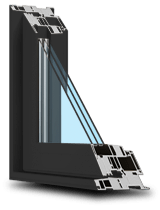
Frame quality matters considerably. Multi-chambered vinyl frames with internal reinforcement handle the temperature swings common in Calgary far better than single-chamber frames. A frame that warps or bows under thermal stress will put pressure on the sealed glass unit and accelerate seal failure. This is one of the reasons the difference between a quality product and a budget product is most evident in Calgary's climate, where the temperature range between a January night and a July afternoon can exceed 50 degrees Celsius.

What the CSA standard says about window lifespan
Windows sold in Canada are subject to performance testing under CSA A440 , which covers air infiltration, water penetration resistance, and structural performance. The standard does not set a fixed lifespan for windows. Instead, it helps define how windows are tested for performance, including air leakage, water resistance, and structural strength. In practical terms, many Canadian homeowners and manufacturers use 20 to 30 years as a planning benchmark for quality vinyl windows, with 25 years being common. When a company offers a “lifetime warranty,” the exact meaning depends on the warranty terms. Homeowners should confirm what is covered, for how long, and whether the sealed glass unit, hardware, frame, and installation labour are treated separately.
This distinction matters when reading warranty terms. A 25-year warranty on vinyl components is meaningful. But it is worth confirming that the sealed glass unit, the hardware, and the installation labour are all covered under the same terms, since these are often itemized separately with shorter coverage periods.
Signs it's time to replace your windows
Some window problems are repair jobs. Others are replacement jobs. Knowing which is which saves money and avoids either replacing windows prematurely or patching over problems that will only get worse.
Visible damage and structural failure
The clearest signals that replacement is necessary rather than repair are structural. Rotted framing around the window opening, water staining on the interior wall below or beside a window, or visible mould in the frame or wall cavity all indicate that moisture has been entering over time. These problems cannot be fixed by resealing the window's exterior. The source of the infiltration needs to be exposed and addressed properly, which typically means removing the window and replacing it with a full-frame installation.
Permanent fogging or condensation between the panes of a double or triple-glazed window is a clear sign that the sealed glass unit has failed. The seal cannot be repaired from the outside. The glass unit needs to be replaced, and if the frame is still in good condition, this can sometimes be done without replacing the full window. An assessment from an experienced installer will tell you which approach makes sense.
Drafts, condensation, and energy loss
Drafts and air leakage around a window do not automatically mean the window needs to be replaced. The most common causes of drafts in otherwise functional windows are worn weatherstripping along the sash edges, cracked or missing caulking around the exterior frame perimeter, or a sash that has shifted slightly out of alignment and no longer closes flush. In many cases, these issues can be addressed without full window replacement, especially when the frame, sealed glass unit, and surrounding wall are still in good condition.
Condensation on the interior glass surface during cold weather is normal and is not a sign of window failure. It indicates that the air in the room is humid and the glass surface is cold. According to Natural Resources Canada , properly installed energy-efficient windows reduce condensation by increasing the temperature of the interior glass surface. If condensation is severe and persistent, upgrading to a better-performing window will help, but the condensation itself is not evidence that the current window has failed.
What signals a problem is condensation that appears between the panes of the glass unit, as noted above, or condensation and water damage on the wall surfaces around the frame. The first is a glass unit failure. The second is a water infiltration problem that requires investigation.
Windows that no longer operate properly
Windows that are painted or sealed shut, that no longer latch correctly, or that require significant force to open and close are telling you something. Hardware failures, such as a broken crank mechanism, a worn locking mechanism, or a hinge that has pulled away from the frame, are usually repair jobs if the frame itself is sound. A window that has warped or shifted to the point where the sash no longer fits the frame is a more significant problem, and whether repair or replacement makes sense depends on the cause and the extent of the movement.
When repairs are enough, and when they're not
The table below is a practical guide to the most common window issues and how to think about whether repair or replacement is the appropriate response.
| May not require full window replacement | Full replacement is likely the better long-term solution |
|---|---|
| Minor drafts caused by worn weatherstripping or small exterior caulking gaps | Persistent drafts caused by frame movement, poor installation, or major air leakage around the window opening |
| Isolated hardware wear, such as a crank, lock, or hinge issue, when the frame and sealed glass unit are still sound | Windows that no longer open, close, or lock properly because the frame or sash has warped, shifted, or deteriorated |
| Light condensation on the interior glass surface during very cold weather | Fogging, moisture, or cloudiness between panes, which usually indicates sealed glass unit failure |
| Minor sash alignment issues with no visible frame damage or water staining | Rotted, warped, cracked, or weakened framing around the window opening |
| Surface-level finish wear with no structural damage | Water stains, mould, soft drywall, or signs of moisture entering around the window |
| Small exterior caulking gaps should be noticed early, before water reaches the wall structure | Repeated caulking failures or visible gaps caused by frame movement or poor fit |
| Windows under 15 to 20 years old that still operate well and show no seal failure | Windows approaching or past 20 to 25 years old with multiple issues, such as drafts, fogging, poor operation, or energy loss |
| Minor comfort issues in one room that may be related to humidity, ventilation, or seasonal temperature swings | Older single-pane or poorly insulated windows in heated living spaces, especially in Calgary’s cold climate |
Note: this table reflects general guidelines. A proper in-home assessment is the only way to determine the right course of action for your specific windows.
A good assessment should look at the actual condition of each window, not just its age. At Canadian Choice Windows & Doors, the goal is to help homeowners understand which windows are still performing, which ones need attention, and where full replacement is the more practical long-term choice. At Canadian Choice Windows & Doors , we assess each window based on its actual condition and give homeowners clear guidance. If full replacement is the right long-term solution, we explain why. If the issue appears minor, we will be upfront about that, too, so you can make an informed decision.
"The first thing we do on any assessment is look at the actual condition of each window. Sometimes homeowners expect to replace everything, but only certain windows are showing clear signs of failure. That kind of honest guidance helps people make the right decision for their home, their budget, and their long-term comfort."
Helen Sin, Consumer Success Manager at Canadian Choice Windows & Doors
How often should windows be replaced in Calgary specifically?
The question of how often to replace windows in Calgary is shaped by the city's climate in practical ways. Calgary's winters are long and cold, with January daily averages sitting around -7.6°C and temperatures regularly dropping below -20°C for extended periods. Summers bring strong UV exposure. The combination of extreme cold, significant freeze-thaw cycling between seasons, and high summer solar radiation places greater stress on windows than moderate climates do.
In practice, this means that windows installed in Calgary may show signs of wear earlier than the same product installed in a more temperate location, particularly if the product was not specifically designed for cold-climate performance. Sealed glass unit failures, frame movement due to thermal expansion and contraction, and weatherstripping wear all occur more quickly when the temperature range is wider.
The practical guidance for Calgary homeowners is this: if your windows are approaching or past 20 years old, have them assessed. Do not wait for an obvious failure.
If your windows are 10 to 15 years old and performing well with no visible issues, there is no urgency. Keep up with basic maintenance and have them checked if you notice any of the warning signs described above. If you are buying or selling a home, a window assessment is worth including alongside any other pre-purchase inspection. Windows are among the higher-cost items to replace in a home, and knowing their condition and remaining lifespan is valuable.
Does replacing windows actually save energy?
The answer depends almost entirely on what you are replacing. The energy savings from new windows vary considerably based on the starting point.
If you are replacing single-pane windows, the improvement in energy performance is substantial. Single-pane glass provides very limited thermal resistance compared with modern double- or triple-pane windows, and every room with a single-pane window is losing heat directly to the outside. Moving to a quality double-pane or triple-pane unit with a low-E coating makes a measurable difference in comfort and heating costs.
If you are replacing double-pane windows that are 10 years old and still performing properly, the energy savings from upgrading to new double-pane windows are modest. The performance difference between a well-functioning 10-year-old double-pane unit and a new one is not large, and the payback period on the investment through energy savings alone would be very long. In this case, the case for replacement is usually comfort, appearance, or the fact that other problems, such as hardware failure or frame deterioration, make repair uneconomical.
In Calgary, energy savings justify replacement in homes with older double-pane windows that have experienced seal failure and lost their insulating gas, or in homes where a full upgrade to triple-pane units with low-E coating is being considered. Triple-pane windows with quality low-E coatings perform meaningfully better than older double-pane units, and in a Calgary home with a long heating season, that performance difference translates into real savings over time.
"Energy savings from new windows are real, but we're always upfront with homeowners about what to expect. If you're replacing single-pane windows, you'll feel the difference immediately. If you're replacing double-pane windows that are still sealing properly, the comfort improvement may still be noticeable, but the return on energy savings alone is usually more gradual. We'd rather set the right expectations than oversell the savings."
Tony Wong, Project Manager at Canadian Choice Windows & Doors
The best time of year to replace windows in Calgary
There is a common assumption that window replacement in Calgary should only happen in summer. In reality, windows can be replaced at any time of year with some straightforward planning.
The genuine constraint is temperature. Sealants and spray foam used during installation need to cure properly, and most products require temperatures above freezing to set correctly. In practice, this means that mid-winter installations in Calgary, when temperatures can sit well below freezing for weeks, require more care and may not be appropriate for certain products or site conditions.
Spring and fall are often the most practical seasons for window replacement in Calgary. Temperatures are consistently above freezing, the installation crews are typically less booked than in peak summer months, and you avoid both the installation delays of summer backlogs and the genuine temperature constraints of deep winter.
If you are planning a replacement project, order your windows at least 6 to 8 weeks before your target installation date. Custom window orders take time, and demand for installations is highest in spring and early summer. Placing your order early gives you the best choice of installation timing and avoids the frustration of waiting longer than expected.
How to make your windows last as long as possible
Regardless of your windows' age, regular basic maintenance is the most cost-effective way to extend their useful life. None of the steps below is difficult or expensive, and together they can add years to your windows' lifespan.
- Inspect and replace weatherstripping annually. Weatherstripping along the sash edges compresses and wears over time. Replacing it when it starts to show gaps or cracks is a straightforward task that eliminates drafts and reduces strain on the window hardware.
- Check and refresh exterior caulking every few years. The caulking line where the window frame meets the exterior wall is the first line of defence against water infiltration. Cracked or missing caulking should be cleared and reapplied before water gets into the wall structure.
- Clean the frame and track regularly. Dirt and debris in the window track or on the frame can interfere with the sash movement and put undue pressure on the hardware. A regular cleaning with mild soap and water keeps things moving freely.
- Lubricate hardware once a year. Crank mechanisms, hinges, and locking hardware all benefit from occasional lubrication. A silicone-based lubricant applied to moving parts prevents wear and makes operation smoother.
- Do not paint or seal operable windows shut. Painting over the sash or sealing the track eliminates ventilation and can trap moisture inside the wall assembly. If a window does not close properly because of a hardware or alignment issue, have it repaired rather than sealed.
- Address small problems before they become large ones. A small air leak around a frame, a stiff latch, or a minor gap in the caulking line are all inexpensive to fix. Left unattended, each of these can allow moisture in and create problems that are considerably more expensive to address.
Frequently Asked Questions
How long do windows last on average?
Quality vinyl windows installed to Canadian standards typically last between 20 and 30 years. Windows built and installed to Canadian performance standards are commonly expected to serve for about 20 to 30 years, with 25 years often used as a practical industry benchmark. CSA A440 focuses on tested performance areas such as air leakage, water penetration resistance, and structural strength, rather than setting one fixed lifespan for every window. The actual lifespan of any specific window depends on installation quality, product quality, climate exposure, and maintenance.
How often should windows be replaced?
There is no fixed schedule. Windows should be replaced when they are failing or when the cost of repair is no longer justified relative to what you would get from replacement. For Calgary homes, windows approaching 20 to 25 years old are worth having assessed, even if there are no obvious problems, since performance degradation often happens gradually before it becomes visible.
How long should windows last before replacement?
A well-made vinyl window installed correctly should give you at least 20 years of reliable performance, and often more. The 25-year mark is the industry benchmark in Canada. Windows that begin showing problems well before 20 years were typically either lower-quality products, poorly installed, or both. A quality product backed by a solid warranty from a reputable installer should reach or exceed that 25-year benchmark.
How often should windows be replaced if they seem fine?
If your windows are operating well, showing no signs of seal failure, drafts, or structural damage, and are under 20 years old, there is no need to replace them on a schedule. Age alone is not a reason to replace. The right trigger for replacement is a condition, not a calendar. That said, if windows are approaching 25 years, a professional assessment is worthwhile to understand what you are working with before problems develop.
What makes vinyl windows last longer?
The two factors that most consistently extend the lifespan of vinyl windows are installation quality and basic maintenance. A window installed with proper sealing, correct shimming, and appropriate flashing will outperform the same product installed carelessly, regardless of brand. On the maintenance side, keeping weatherstripping in good condition, regularly refreshing exterior caulking, and addressing small issues before they escalate are the most effective steps a homeowner can take to protect their investment.

1000’s of Colours & Textured Finishes
Transform your home from ordinary to extraordinary with our new coloured and non-glare textured finishes. Available in a wide array of colours as well as custom matched colours for your very own personalized design.
Our Most Popular Replacement Window Colours: