Security Film: A Practical Guide for Homeowners
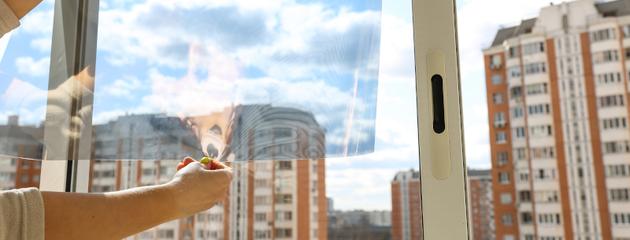

Glass is one of the most vulnerable parts of a home’s exterior. In a break-in attempt or a severe wind event, it doesn’t take much for a window or patio door to fail, and once it does, the risk is not only property loss but also flying shards inside the home.
Security film for windows is a retrofit solution designed to change what happens after glass breaks. This guide explains how security film works, what level of break-in delay it can realistically provide, how it performs in Canadian weather, what affects its lifespan, and when a full window replacement is the smarter long-term move.
Key Takeaways
- Security film reinforces existing glass by holding shattered pieces together after impact.
- Properly installed, multi-layer polyester security film can reduce the risk of injury from flying glass.
- Security film works best as part of a broader home protection strategy — including reinforced frames and alarm systems.
- It may help limit flying glass during ice storms and high-wind events, but it does not make windows hurricane-rated.
- In Canadian climates, lifespan typically ranges from 10 to 20 years, depending on UV exposure and installation quality.
What Is Security Film and How Does It Protect Your Windows?
Security film is a multi-layered polyester film applied directly to the interior surface of existing window glass. It is bonded using strong pressure-sensitive adhesives that create a reinforced layer across the pane.
When untreated glass breaks, it fractures into sharp shards that scatter in either direction. With properly installed security film, those fragments adhere to the film layer. Instead of collapsing immediately, the pane often remains intact within the frame.
How Security Film Is Manufactured
Security films are typically constructed from multiple layers of polyethylene terephthalate (PET), a strong and clear plastic material commonly used in protective films. These layers are bonded together to achieve different thickness ratings, commonly measured in mil (thousandths of an inch).
Typical residential security films range from:

- 4 mil (light protection)
- 8 mil (moderate reinforcement)
- 12–15 mil (high-strength security applications)
Thicker films generally provide greater resistance to tearing and stretching under force. In practical terms, that means more effort is required to create an opening through the broken glass after impact. The thicker the film, the greater the tear resistance and energy absorption capacity. Increased thickness also improves the film’s ability to hold fractured glass fragments together, helping maintain a temporary barrier after breakage.
During manufacturing:
- PET layers are laminated together.
- Scratch-resistant coatings are applied.
- UV inhibitors may be added.
- Pressure-sensitive adhesive is integrated for bonding.
Each layer plays a specific role in overall performance. Laminating strengthens structural integrity, coatings help preserve clarity over time, and UV inhibitors can reduce long-term material degradation while limiting ultraviolet transmission into the home. The result is a clear, flexible barrier engineered to absorb impact energy. When professionally installed, it remains virtually invisible on the glass while significantly improving post-break fragment retention behaviour.
How It Holds Shattered Glass in Place
When impact occurs — whether from a blunt object or storm debris — untreated annealed glass fractures into sharp pieces. Security film helps:
- Distribute impact energy across the surface.
- Prevent immediate shattering collapse.
- Hold broken shards together in a spider-web pattern.
This is known as a fragment retention system. Laboratory testing of safety and security window films demonstrates that properly installed multi-layer polyester films can improve glass fragment retention after breakage. This helps reduce the risk of flying shards and delays the immediate opening of the formation, but it does not convert standard glass into impact-rated hurricane glazing.
Decorative vs. Protective Window Film
Homeowners often confuse decorative film with security film. They are not interchangeable.
| Feature | Decorative Film | Security Film |
|---|---|---|
| Primary Purpose | Privacy or design | Impact resistance & glass retention |
| Thickness | 1–2 mil | 4–15 mil |
| Break-In Resistance | None | Provides delay |
| Storm Protection | None | Reduces flying glass risk |
| Structural Reinforcement | No | Yes (when properly installed) |
Decorative films may frost or tint glass, while security films reinforce it — and that difference directly impacts safety performance by determining how the glass behaves after it breaks. In short, one is designed for appearance, the other for protection and post-impact control.
Technical Specifications Overview
Below is a general comparison of typical residential security film properties:
| Specification | Typical Residential Security Film |
|---|---|
| Material | Multi-layer PET polyester |
| Thickness | 4–15 mil |
| Tensile Strength | Varies by manufacturer and film thickness |
| Break Strength | 100–200+ lbs per inch width |
| Adhesion Type | Pressure-sensitive adhesive |
| UV Rejection | Up to 99% UV reduction (optional) |
| Optical Clarity | High (minimal distortion when installed correctly) |
Performance depends heavily on installation quality and the condition of the frame. Security film performance depends on measurable properties such as tensile strength, energy absorption, and adhesive bonding. Its primary purpose is not to stop the glass from breaking, but to help control what happens after breakage by holding fragments in place.
How Does Security Film for Windows Improve Home Safety?
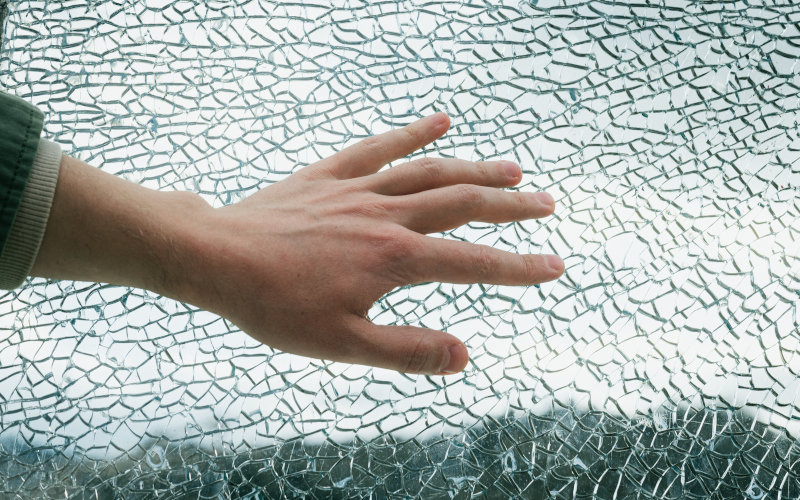
Alt: Close-up of a man’s hand touching shattered glass fragments, showing how safety film holds glass together for added protection.
Most residential break-ins are not subtle. According to Statistics Canada crime reporting data, forced entry remains a common method in property crime. Smash-and-grab tactics are fast, loud, and designed to exploit weak points — often glass.
Break-In Resistance and Time Delay
Security film operates on what security professionals often refer to as the time-delay principle — it does not prevent glass from breaking, but it changes what happens after impact. When a window without reinforcement is struck, entry can occur within seconds. With security film applied, the sequence slows down significantly:
- Multiple blows may be required.
- Glass may crack but remain attached.
- Entry becomes more physically demanding.
- Noise and visibility increase during the attempt.
And that extra time matters. Criminology research consistently shows that intruders prefer low-risk, low-effort entry points and typically avoid situations that draw attention or require sustained force. If forced entry becomes loud, physically demanding, or prolonged, many opportunistic offenders abandon the attempt. Security film does not make windows impenetrable, but it can meaningfully discourage smash-and-grab intrusion by increasing effort, exposure, and risk.
Impact Absorption During Storms
In severe weather conditions — particularly in high-wind regions — flying debris can cause glass breakage. While Canada is not a hurricane-prone country like Florida, windstorms and severe weather events still pose risks.
Security film helps by:
- Reducing interior glass scatter.
- Limiting dangerous projectile shards.
- Keeping broken panes partially contained.
This does not replace storm-rated glazing systems, but it improves post-break safety performance.
Injury Reduction From Shattered Glass
Broken glass injuries can be severe, particularly in homes with children or pets. When untreated glass fails, sharp fragments can scatter across floors, furniture, and high-traffic areas within seconds, increasing the risk of cuts and secondary injuries during evacuation or cleanup.
Security film reduces:
- Deep laceration risk from airborne shards.
- Glass fallout into interior living spaces.
- Cleanup hazards following breakage.
By containing fragments against the film layer, it helps limit how far broken pieces travel and how widely they disperse. Even when glass fails, this controlled break pattern enhances overall home safety and reduces the likelihood of serious injury.
Real-World Safety Scenarios
Consider a basement window — often less visible from the street. Without reinforcement, a single strike may create immediate access.
With security film:
- The pane fractures but holds.
- The intruder must physically tear through the film.
- The added resistance increases detection likelihood.
Or during a windstorm, when debris impacts a patio door. Instead of shattered glass across the living room, the film retains fragments in place, limiting exposure to injury. These scenarios illustrate how fragment retention can reduce risk in real-world situations.
Helen Sin, Consumer Success Manager at Canadian Choice Windows & Doors , explains:
“Homeowners often assume security film makes glass unbreakable. That’s not the case. What it really does is buy you time and reduce the danger of shattered glass. It’s about improving safety outcomes, not creating a false sense of invincibility.”
Can Security Film Help During Extreme Canadian Weather Conditions?
Canadian weather is not uniform. Wind speeds, ice accumulation, and flying debris risks differ significantly between provinces. Security film does not prevent glass breakage under extreme force. What it does is improve post-break performance by helping fractured glass remain adhered to the film layer rather than scatter.
Ice Storms and Flying Debris
Ice storms, high winds, and other severe weather events are recurring hazards across multiple provinces, including Ontario, Quebec, and Atlantic Canada. Ice accumulation increases structural stress on building components, while strong winds raise the likelihood of debris striking exterior glazing.
When standard glass breaks due to impact, it typically fractures into loose shards that can scatter indoors. Security film is engineered to improve fragment retention by helping broken glass adhere to the film layer rather than dispersing freely.
Security film contributes in two ways:
- Helps retain shattered glass fragments.
- Reduces interior glass fallout during breakage.
Severe weather events remain a major source of insured property losses nationwide. While security film does not prevent window breakage under extreme force, improved glass containment may help reduce secondary interior damage and reduce injury risk from airborne shards.
Wind Loads and Provincial Comparisons
Wind exposure differs significantly across Canadian regions due to geography and prevailing weather patterns.
Alberta is known for strong Chinook winds and intense summer storm systems that may include hail and short-duration high gusts. These events can generate sudden pressure fluctuations on building envelopes, particularly on exposed elevations.
The Maritime provinces — Nova Scotia , New Brunswick, and Prince Edward Island — are more frequently affected by coastal storm systems. These events can bring prolonged periods of strong winds, heavy precipitation, and elevated exposure to wind-driven debris, especially in shoreline and open areas.
Official meteorological summaries report that severe storm events in both western and eastern regions have produced peak wind gusts exceeding 100 km/h. In western provinces, wind events are often associated with convective storm activity, while eastern coastal regions may experience sustained wind fields linked to large-scale storm systems.
Regional wind patterns influence how homes are designed, especially in areas exposed to strong storms or flying debris.
| Region | Primary Weather Risk | Glass Impact Risk | Security Film Role |
|---|---|---|---|
| Alberta | High winds, hail | Sudden impact | Fragment retention, reduced interior scatter |
| Maritimes | Coastal storms, windborne debris | Sustained pressure & debris | Glass containment after fracture |
Security film does not replace CSA-certified impact-resistant glazing systems where required by building code. However, it may reduce the risk of interior injuries from broken glass during extreme weather.
CSA Group standards related to window performance (such as the CSA A440 series for windows and doors ) focus on structural and air- and water-performance. Security film itself is not a substitute for certified impact-rated assemblies under these standards.
Insurance Considerations
Home insurance policies vary. Some insurers recognize upgrades that reduce risk, particularly reinforced glazing or laminated glass. Security film may not qualify as an impact-rated upgrade, but fragment retention could potentially reduce claim severity by limiting interior damage.
Homeowners should consult their insurer directly to determine whether security film affects premiums or coverage eligibility.
Tony Wong, Project Manager at Canadian Choice Windows & Doors , adds:
“Frame condition and installation quality are critical. Film improves fragment retention, but the overall window assembly determines how the system performs during wind load events.”
How Long Does Protective Window Film Last?
Most high-quality residential security films have an expected lifespan between 10 and 20 years, depending on manufacturer specifications, UV exposure, and installation quality.
According to industry manufacturer guidelines (including major North American film producers), longevity depends on:
- Direct sunlight exposure
- Interior humidity levels
- Installation technique
- Edge sealing integrity
Climate Influence in Canada
Canadian climates introduce variability.
- High UV exposure in prairie provinces may accelerate adhesive aging over time.
- Coastal humidity in Atlantic regions can influence edge durability if not properly sealed.
- Extreme temperature swings — common in central Canada — can affect long-term adhesive performance.
Proper installation significantly influences service life. Professional installation reduces the risks of early failure.
Signs of Film Failure
Homeowners should monitor for visible deterioration. Common indicators include:
- Bubbling or blistering
- Peeling at the edges
- Discolouration
- Visible adhesive separation
If these signs appear, performance may be compromised. Regular inspection — particularly after severe weather events — is advisable.
It’s important to note: window film warranties vary. Some manufacturers offer 10–15-year warranties depending on product category and installation certification.
Is Security Film the Right Investment for Your Home?
Security film is best understood as a glass safety enhancement, not a structural upgrade. It is designed to improve how glass behaves after it breaks, helping to contain fragments and reduce immediate hazards inside the home. While it can meaningfully increase resistance and delay, it does not alter the window assembly's underlying structural capacity.
It offers:
- Improved glass fragment retention
- Reduced interior injury risk
- Added delay in forced entry scenarios
- Moderate storm-related glass containment
It does not:
- Replace laminated impact glass
- Upgrade windows to hurricane-rated systems
- Reinforce weak window frames
Decision Checklist
Security film may be suitable if:
- You want to improve glass safety without replacing windows.
- Your frames are structurally sound.
- You understand its limitations.
- You are seeking fragment control rather than impact certification.
It may not be sufficient if:
- You live in a region requiring impact-rated glazing by code.
- Your window frames are deteriorating.
- You require certified structural storm resistance.
Ultimately, the right choice depends on your goals, your regional risk exposure, and the condition of your existing window system. When viewed realistically — as part of a layered approach to home safety — security film can be a practical enhancement rather than an overinvestment.
Choosing and Installing Security Film for Your Home
Selecting security film is not simply about thickness. Performance depends on placement strategy, installation quality, and how the film integrates with the existing window assembly. Because security film improves post-break behaviour — not structural capacity — thoughtful planning is essential.
Understanding where to install it, who should install it, and how it may affect your home’s appearance helps ensure realistic expectations and long-term performance.
Where Should Security Film Be Installed for Maximum Protection?
Security film does not need to be applied to every pane of glass in a home. Strategic placement often provides the greatest benefit.
Priority areas typically include:
- Ground-floor windows not visible from the street
- Basement windows
- Glass panels near door locks
- Patio doors and large sliding glass doors
- Side or rear entry doors with glazing inserts
These areas are more frequently targeted in forced-entry attempts because they offer privacy and quicker access.
For weather-related risk, homeowners in high-wind regions may prioritize:
- Large west-facing or wind-exposed elevations
- Patio doors facing open landscapes
- Windows near outdoor furniture or potential debris sources
Security film is most effective when applied to intact, structurally sound glass and frames. If the frame system is deteriorating or loosely anchored, fragment retention may still occur — but overall performance will be limited by the weakest component in the assembly.
Rather than a blanket installation, a targeted approach often provides better cost-efficiency while addressing the highest-risk areas.
Professional Installation vs. DIY — What Homeowners Should Know
While security film kits are available for consumer purchase, the quality of installation significantly influences performance.
Security film relies on:
- Proper surface preparation
- Precise trimming and edge finishing
- Correct adhesive bonding
- In some cases, structural edge attachment systems
Improper installation may result in:
- Poor adhesion
- Edge lifting over time
- Reduced fragment retention during breakage
- Visible distortion or bubbling
Security film installation is typically performed by specialized contractors and is separate from full window replacement services. In some higher-security applications, mechanical edge attachment systems are used to improve retention performance during forceful impact. These systems are rarely part of DIY installations.
For homeowners considering a retrofit solution, professional installation provides greater reliability and typically aligns with manufacturer warranty requirements.
Security film performance is highly dependent on how well it bonds to the glass — not just the product itself.
Does Security Film Affect Window Appearance or Energy Efficiency?
One of the advantages of modern security film is optical clarity. When professionally installed, high-quality multi-layer polyester film is nearly invisible.
Most residential security films:
- Maintain high visible light transmission
- Introduce minimal optical distortion
- Do not significantly alter exterior aesthetics
However, certain versions may include additional features, such as UV-rejection coatings. Some products can block up to 99% of ultraviolet radiation, which may help reduce interior fading of flooring and furnishings.
In terms of energy performance, security film is not designed as a primary insulation upgrade. It does not replace low-E coatings or improve the glazing unit's structural thermal performance. Any minor reduction in solar heat depends on the specific product type.
Homeowners seeking significant energy-efficiency improvements should consider full-window replacement. Security film is intended to improve safety and post-break behaviour — not to function as an energy retrofit system.
When expectations align with its purpose, security film can enhance protection without altering the home's appearance.
Final Assessment: Is Security Film the Right Choice for Your Home?
Security film is best viewed as a safety upgrade for existing glazing — not a structural replacement. It can hold shattered glass together, reduce injury risk, and create a meaningful time delay during forced-entry attempts, especially when the film is professionally installed on priority windows and doors.
If your frames are in good condition and you are looking for a temporary safety enhancement, security film may offer limited improvement. However, when long-term structural performance, energy efficiency, and durability are priorities, full window replacement is typically the more comprehensive solution. But if your window system is deteriorating, you need certified impact performance, or you’re trying to meaningfully improve energy efficiency, replacement windows and doors will deliver a more complete solution.
Frequently Asked Questions About Security Film for Windows
Can security film stop someone from breaking my window?
No. Security film does not prevent glass from breaking. What it does is hold shattered glass together after impact, making forced entry slower and more physically demanding. In many cases, this added delay increases noise and visibility, which may discourage opportunistic intruders.
How much does security film for windows typically cost in Canada?
Costs vary depending on film thickness, total square footage, accessibility of the glass, and whether professional installation is required. Larger patio doors and multi-pane units generally increase labour time. Homeowners should consult a certified security film installer to understand realistic pricing based on their window configuration.
Can security film be applied to double-pane or low-E windows?
Yes, in most cases, security film can be applied to the interior surface of insulated glass units. However, compatibility depends on glass type, seal condition, and manufacturer guidelines. Professional evaluation helps avoid issues such as seal stress or thermal imbalance.
Will security film make my home look darker?
Most modern residential security films are optically clear and maintain high light transmission. While some products include UV or solar-control features, high-quality film is designed to remain virtually invisible when installed correctly.
When is full window replacement a better option than security film?
Replacement may be more appropriate if:
- Window frames are deteriorating
- Air leakage or insulation performance is poor
- You require certified impact-rated glazing
- You want significant energy-efficiency improvements
Security film improves safety behaviour after breakage. New window systems improve structural performance, energy efficiency, and overall envelope strength.

1000’s of Colours & Textured Finishes
Transform your home from ordinary to extraordinary with our new coloured and non-glare textured finishes. Available in a wide array of colours as well as custom matched colours for your very own personalized design.
Our Most Popular Replacement Window Colours: