Comparing patio door types: which one suits your home?


A patio door is one of the largest single openings in most Canadian homes. It shapes how much daylight reaches the room, how the indoor space connects to the yard, how well the home holds heat in winter, and how secure the back of the house feels.
Choosing the right type matters more than the colour or hardware finish. A sliding door works in a space where a French door doesn't. A bifold creates an opening that no other type can match. This guide walks through the five patio door types most often considered in Canadian homes, what each one is best for, and what to look for before deciding.
Key takeaways
- Five patio door types are common in Canadian homes: sliding, French, bifold, stacking, and tilt-and-turn. Each suits a different layout and use case.
- Sliding doors save space and seal tightly, generally the most energy-efficient option for typical openings.
- French doors open fully from the centre and look elegant, but need clearance on the swing side and can be harder to seal.
- Bifold and stacking doors create wide indoor-outdoor openings for larger backyards or patios.
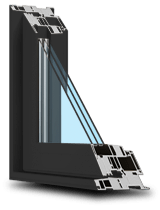
- Frame material affects insulation, durability, and maintenance. Canadian Choice Windows & Doors manufactures patio doors in uPVC (sliding) and Thermal Commercial Grade Aluminum (stacking).
- Measurements matter. Take the width at three points (top, middle, bottom) and use the smallest of the three. Confirm depth before ordering.
Why the right patio door matters
Patio doors are part structural opening, part design element, and part energy decision. The wrong choice can mean drafts in winter, hot rooms in summer, awkward furniture placement, or a backyard that feels disconnected from the home. The right choice does the opposite; it makes the room brighter, the home easier to heat and cool, and the outdoor space feel like an extension of the interior.
Three benefits drive most replacement decisions:
- Energy efficiency: modern patio doors with double or triple-pane glass, Low-E coatings, and proper weatherstripping reduce heat transfer significantly compared to older single-pane sliding doors.
- Security: multi-point locking systems, impact-resistant glass, and reinforced frames address the most common vulnerability in patio doors. Patio doors are often easier to force than front doors.
- Daylight and access: a well-sized patio door brightens the entire room behind it, and a smooth-operating door encourages you to use the outdoor space rather than avoid it.
The five patio door types worth knowing

Five patio door types are common in Canadian homes. Each one solves a different problem, and each one has trade-offs worth understanding before you decide.
1. Sliding patio doors
A sliding patio door has two or more glass panels in a single frame. One panel is fixed; the other slides horizontally along a track behind it. Sliding doors are the most common patio door style in Canadian homes, and there's a practical reason for that.
They don't need swing clearance on either side. They give you a wide expanse of glass for natural light. And because the panels slide along a track rather than swinging on hinges, they're not affected by wind the way swinging doors can be. Modern sliding doors use multiple weatherstripping seals at each track interface and a thermally insulated glass unit sealed to the sash on both sides, which minimizes drafts and heat loss.
Best for:
- Small or medium openings with limited swing clearance.
- Modern or minimalist interiors.
- Homes with kids or pets, where a sliding mechanism is safer than a swinging door.
- Maximizing daylight without breaking the wall up with hardware.
Things to consider:
- Only half the door opens, so the maximum opening is roughly the width of one panel.
- The track needs to stay clean for smooth operation.
- Screens slide separately on a parallel track.
Canadian Choice Windows & Doors DraftLOCK sliding patio doors are made of uPVC with Low-E-coated double- or triple-pane glass, multi-point locking, and water-resistant sill construction.

2. French patio doors
French patio doors , also called garden doors or hinged patio doors, are two doors hinged on opposite sides, swinging open from the centre. Each panel has a full-height glass insert. When both panels open, you get a wide, unobstructed entrance to the patio with no central post or track in the way.
French doors give you the most generous opening of any standard patio door style. They're also the most traditional in appearance, which is why they're often chosen for heritage homes, formal interiors, or any home where the patio door is a visible design feature.
Best for:
- Larger openings (typically 5 feet wide or more) where you want a full entrance, not just half.
- Traditional, transitional, or classic-style homes.
- Homes where ventilation matters — both panels can open fully for maximum airflow.
- Frequent indoor-outdoor entertaining, where the wide opening adds to how the space functions.
Things to consider:
- You need clearance for the doors to swing. Inswing doors take indoor floor space; outswing doors need clear deck or patio space.
- Wind can affect them more than sliders — outswing doors should have proper hinge support and, ideally, a holdback to prevent slamming.
- Sealing is more demanding than on sliders. The double-door interface at the centre needs an effective astragal and weatherstripping to stay airtight.
- Wider openings (over 6 feet) may require structural support, since you're removing more wall than a sliding door would.

3. Bifold (folding) patio doors
Bifold doors are a series of panels hinged together that fold and stack against one side of the opening when fully open. The result is a near-complete opening of the wall — much wider than any sliding or French door can give you. They're a relatively new addition to the Canadian patio door market, but increasingly common on modern builds and major renovations.
When closed, the panels function as a continuous wall of glass. When open, the whole opening clears, creating a true indoor-outdoor space.
Best for:
- Large openings, typically 8 feet or more wide, sometimes spanning the entire back wall.
- Modern architecture where the patio door is a major design feature.
- Homes that entertain outdoors regularly.
- Spaces designed to blur the indoor-outdoor boundary.
Things to consider:
- Cost is higher than for sliding or French doors, due to more hardware, larger glass units, and more complex installation.
- The folded panels stack on one side, so that side of the opening needs clear space.
- Sealing complexity is higher: each panel interface requires weatherstripping, and the threshold must accommodate multiple panel feet.
- Installation usually requires a structural assessment bifold doors often replace a load-bearing section of wall.

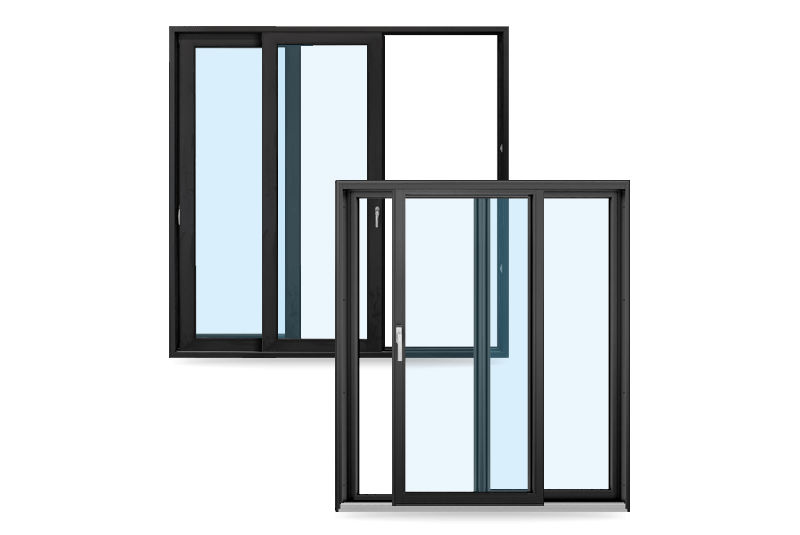
4. Stacking patio doors
Stacking patio doors are a variant of sliding doors with three or more panels. Instead of two panels overlapping (one fixed, one sliding), the operable panels slide along separate tracks and stack behind each other when open. Some configurations let the stacked panels tuck into a hidden wall pocket, giving you almost a complete opening similar in feel to a bifold but operating differently.
Canadian Choice Windows & Doors manufactures stacking patio doors in thermal commercial-grade aluminum. The panels can be configured to open to one side or split from the centre, giving you flexible control over how much of the opening is exposed.
Best for:
- Openings wider than a standard two-panel slider can handle (usually over 8 feet).
- Modern homes that want the cleaner aesthetic of a sliding door at scale.
- Spaces where bifold's stacked panels would be in the way.
- Owners who want the option of a 180-degree panorama view but not the cost or complexity of a bifold.
Things to consider:
- Track maintenance is more involved than a two-panel slider — more tracks, more rollers.
- Frame depth is greater than a standard slider.
- Available in commercial-grade aluminum at Canadian Choice Windows & Doors; not currently offered in uPVC.
5. Tilt-and-turn patio doors
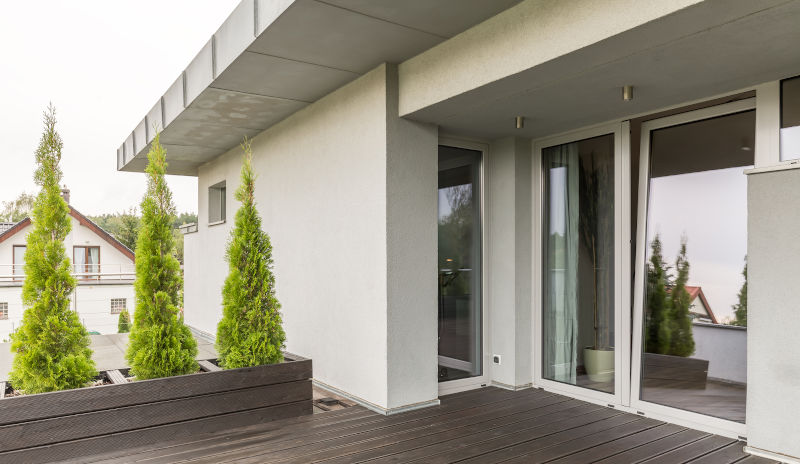
Tilt-and-turn patio doors borrow the mechanism from European tilt-and-turn windows. A single handle controls three positions: locked, tilted inward at the top for secure ventilation, or swung fully open inward like a regular door. They're less common than the other four types in Canada but worth knowing about, particularly for condos, upper-floor walkouts, or any setting where outward swing isn't practical.
Best for:
- Upper-floor balconies or terraces where an outward swing would be a problem.
- Condos with shared exterior space.
- Rooms where you want the option of ventilation without opening the full door.
- Modern interiors with a European design aesthetic.
Things to consider:
- The full open position requires inward clearance — furniture can't sit close to the door.
- More expensive than standard sliding doors due to the European hardware and multi-point locking system.
- Less common in Canada, so fewer suppliers offer it. Canadian Choice Windows & Doors manufactures tilt-and-turn patio doors as part of its product line.
Patio door types at a glance
| Type | Best for | Strengths | Watch for |
|---|---|---|---|
| Sliding | Most homes — small to medium openings | Space-saving, strong seal, wide glass area | Only half opens |
| French | Larger openings, traditional homes | Full-width opening, elegant look | Needs swing clearance; sealing is more demanding |
| Bifold | Wide openings, indoor-outdoor design | Near-complete wall opening | Higher cost; a structural review is usually needed |
| Stacking | Wide openings, modern interiors | 180-degree panorama; clean sliding aesthetic | Greater frame depth; more tracks |
| Tilt-and-turn | Condos, upper floors, modern homes | Dual-function; opens inward; secure ventilation | Needs inward clearance; higher cost |
How to measure a patio door opening
Accurate measurements matter more on a patio door than on most other openings. A door that's even slightly off can create gaps that lead to drafts, water leaks, and uneven sealing. The basics:
- Width: measure across the opening at the top, middle, and bottom. Old openings often aren't perfectly square. Use the smallest of the three measurements.
- Height: measure from the floor to the top of the frame at the left side, the centre, and the right side. Use the smallest.
- Depth: measure the wall thickness from the interior face to the exterior face. This determines what door depth will fit and whether jamb extensions are needed.
- Squareness: check that the corners are at 90 degrees, or note any deviation. Significant out-of-square openings may require framing adjustments before the new door is installed.
If any of this feels uncertain, leave it to the installer. A Canadian Choice Windows & Doors in-home consultation includes professional measurements before the order is placed. There's no cost or obligation, and measurements taken in the home are far more reliable than approximations from photos or floor plans.
“The mistake we see most often is homeowners measuring once and ordering a door that turns out to be the wrong size. Patio door openings are almost never perfectly square, especially in older homes. We measure at multiple points before every order, and we check the framing condition while we're there. It's faster to fix a hidden issue before the new door arrives than to discover it during install.”
— Tony Wong, Project Manager, Canadian Choice Windows & Doors
Patio door frame materials
Four frame materials are common on Canadian patio doors. Each has different strengths in cost, insulation, durability, and maintenance.
| Material | Strengths | Trade-offs |
|---|---|---|
| uPVC (vinyl) | Affordable. Low maintenance. Strong thermal performance. Weather-resistant. Canadian Choice Windows & Doors sliding patio doors are built in uPVC. | Colour customization is broader now than in past years, but factory finishes are still the standard. |
| Aluminum (thermally broken) | Strong, lightweight, and supports larger panels. Canadian Choice Windows & Doors' stacking patio doors use Thermal Commercial-Grade Aluminum. | Without a thermal break, aluminum conducts heat. Commercial-grade aluminum with a thermal break solves this. |
| Fibreglass | Strong thermal performance. Resists warping, denting, and rot. Holds paint well. | Higher cost than uPVC. Not part of the Canadian Choice Windows & Doors patio door line. |
| Wood | Classic appearance. Natural insulator. Often paired with French door designs. | High maintenance — staining, sealing, refinishing. Sensitive to moisture and freeze-thaw cycles. |
Inswing, outswing, or sliding: choosing the opening style
Beyond the door type, the way it opens affects how much interior space the door takes up, how it handles weather, and how secure it feels.
- Inswing French doors open into the room. Better for homes with limited outdoor patio space, but they take up indoor floor space and can interfere with furniture placement near the door.
- Outswing French doors open onto the patio or deck. Better for homes where indoor floor space is at a premium. Also slightly more weather-protected, since rain and snow don't enter as easily when the doors are briefly opened.
- Sliding doors don't swing at all. Both indoor and outdoor floor space stays free. The trade-off is that only one panel opens, so the effective opening is half the door's total width.
- Inward-swinging tilt-and-turn doors are common on European-style installations and useful in condos where outward swing isn't allowed.
For homes in cold climates, the seal matters more than the swing direction. A well-sealed inswing door will outperform a poorly sealed outswing door in winter, regardless of which way it opens.
Patio door energy efficiency: what actually matters
Patio doors are among the largest glass surfaces in most homes, making them a major source of heat loss. The good news is that modern patio doors can perform nearly as well as a quality window, provided the right components are in place.
Glass
- Double-pane glass is the baseline for Canadian climates. Two panes with an air or argon gas fill between them.
- Triple-pane glass adds a third pane, significantly increasing thermal resistance. Worth considering in cold regions or for patio doors facing north or large enough to be a significant heat-loss point.
- Low-E coatings reflect infrared heat back into the room in winter and block UV rays year-round. Standard on modern energy-efficient patio doors.
- Argon gas fills between the panes, slowing heat transfer. Most quality manufacturers include this by default.
- Warm-edge spacers, the strips that separate the panes around the perimeter, reduce heat loss at the edges of the glass unit, which is one of the weakest points in any glazed assembly.
Frame and seal
- Insulated uPVC frames hold their shape and resist thermal bridging. Hollow frames perform worse than solid or reinforced frames.
- Weatherstripping at every panel interface. On sliding doors, multiple weatherstripping seals at each panel and along the panel meeting points make a measurable difference in air infiltration.
- Thermal break on aluminum frames. Without one, aluminum will conduct cold straight through the frame, defeating the glass's insulation.
- Threshold and sill design. A self-draining sill that directs water outward stops leaks and improves air sealing.
Canadian Choice Windows & Doors patio door energy specs
- DraftLOCK uPVC sliding patio doors include double or triple-pane glass with Low-E coatings.
- Frame depth and triple-sealing construction match the Canadian Choice Windows & Doors window line.
- Glass packages can be configured for cold-climate ER ratings or for sound-attenuation specs (for homes near busy roads).
- Up to 30% improvement in home energy rating compared to older patio doors, through air-leak prevention and improved glass packages.
Patio door security: what's standard and what's worth adding
Patio doors used to be the weakest point in many homes. The standard latches on older sliding doors were easy to defeat, and single-pane glass broke without much effort. Modern patio doors are significantly more secure, but only if the security features are actually there.
What to look for
- Multi-point locking system. Engages the door at multiple points (top, middle, bottom) rather than relying on a single centre latch.
- Reinforced strike plates. Distribute force across a wider area of the frame.
- Foot-operated secondary lock at the base of the door. Useful for venting, position security keeps the door closed while still allowing a small opening for airflow.
- Tempered or laminated safety glass. Tempered glass shatters into small, blunt pieces rather than sharp shards. Laminated glass holds together even when broken, preventing easy entry.
- Exterior D-handle. Ergonomic and resistant to forced entry — the industry-standard handle design on quality sliding patio doors.
Extras to consider
- Security pin or door bar. A simple, inexpensive addition that stops the door from being lifted off its track or forced sideways.
- Smart locks. Available on some patio door configurations, though less common than on entry doors.
- Motion-detection exterior lighting near the door. Doesn't change the door itself, but significantly reduces its appeal as an entry point.
“The first question I'd ask before choosing a patio door style is what the room behind it will be used for. A door that suits a quiet sitting room can be the wrong choice for a family room that opens onto a kids' play area. Style matters, but the practical question of how often you will actually open it, and what's on the other side, usually points to the right answer.”
— Helen Sin, Consumer Success Manager, Canadian Choice Windows & Doors
Patio doors and bedroom egress
If a patio door serves a room used as a bedroom, for example, a master bedroom with a walkout to the deck, it must meet egress requirements under the National Building Code. The clear opening must be at least 0.35 m² (3.77 sq ft) with no dimension under 380 mm (15 inches), so a person can exit in an emergency.
Most standard patio doors meet this requirement easily — they're much larger than the minimum. The exception is rooms where the patio door is the only operable exit and the operating panel is unusually narrow. If you're replacing windows or a patio door in a basement bedroom or any room used for sleeping, confirm egress compliance with your installer during the in-home consultation. Provincial and municipal codes can vary slightly from the national guidelines.
Questions to ask before ordering
- What's the glass package: double- or triple-pane, Low-E coating, argon gas fill?
- What kind of weatherstripping is used at the panel interfaces?
- What's the locking system: single latch, or multi-point?
- Is the sill self-draining?
- Is the screen included, and how does it operate?
- Is the installation done by the manufacturer's own team or a subcontractor?
- What does the warranty cover, for how long, and is it transferable if you sell the home?
All of these matter more than the colour or hardware finish you choose. The visible details affect curb appeal; the invisible ones affect how the door performs after a decade of use.
Why Canadian homeowners choose Canadian Choice Windows & Doors for patio doors
Canadian Choice Windows & Doors has been serving Canadian homes for over 40 years. Every patio door is manufactured in Canada at our facility, custom-built to your opening, and installed by our own in-house teams, without subcontractors.
- Recommended by Bryan Baeumler, HGTV host and Canada's recognized construction expert.
- Over 3,100 positive reviews on HomeStars.
- More than 1 million windows and doors have been installed across Canada.
- 25-year transferable warranty on every patio door.
- DraftLOCK uPVC sliding patio doors with Low-E coated double or triple-pane glass.
- Thermal Commercial Grade Aluminum stacking patio doors (three or more panels) for wide openings, including 180-degree panorama configurations.
- Tilt-and-turn patio doors for condos and modern installations.
- Multi-point locking, reinforced frames, and water-resistant sill construction across all types.
- In-home consultation with professional measurements and a dedicated project manager from quote to installation.
Frequently asked questions
Which patio door type is most energy-efficient?
Sliding patio doors generally seal the tightest because the panels don't swing; there's no swing-side seal that has to compress every time the door is operated. Modern sliding doors with triple-pane glass, Low-E coatings, and multiple weatherstripping seals are among the most energy-efficient patio door options on the Canadian market. French doors can match this performance if properly sealed at the centre interface, but the additional sealing complexity makes air leakage more common.
Are sliding patio doors secure?
Modern sliding patio doors are significantly more secure than older models. Look for a multi-point locking system, a reinforced exterior D-handle, an optional foot-operated secondary lock, and tempered or laminated safety glass. Canadian Choice Windows & Doors DraftLOCK sliding patio doors include multi-point locking and impact-resistant glass options. A simple security pin or door bar is also a cheap, effective addition.
What's the difference between sliding and French patio doors?
Sliding doors have panels that move along a track, with one fixed and one (or more) operable. French doors have two panels hinged on opposite sides that swing open from the centre. Sliding doors save space and seal tightly; French doors offer a wider full opening and a more traditional look, but require swing clearance.
Can French patio doors open inward or outward?
Both. Inswing French doors open into the room and protect the doors from outdoor weather; outswing doors keep the indoor floor space free. The choice usually comes down to whether you have more flexibility with interior or exterior clearance. In cold climates, outswing doors are slightly less common because snow can pile up against the threshold.
What are bifold patio doors, and when should I choose them?
Bifold doors consist of hinged panels that fold and stack against one side of the opening. They give you the widest indoor-outdoor opening of any patio door type, often spanning 8 feet or more, sometimes the entire back wall. Choose them for large openings, modern architecture, and homes that regularly use the patio for entertaining. They cost more than sliding or French doors and usually require a structural assessment.
What's the best frame material for a patio door in Canada?
For most homes, uPVC (vinyl) is the practical first choice, affordable, low-maintenance, weather-resistant, and well-suited to Canadian freeze-thaw cycles. Canadian Choice Windows & Doors manufactures sliding patio doors in DraftLOCK uPVC. For wide openings or stacking configurations, thermally broken commercial-grade aluminum performs well. Fibreglass and wood are also options, but with a higher cost and (for wood) higher maintenance.
How long do patio doors last?
A well-installed patio door with a uPVC or aluminum frame typically lasts 25 to 30 years or more. Lifespan depends on frame quality, hardware quality, installation precision, and ongoing maintenance, particularly keeping the tracks clean, the rollers aligned, and the weatherstripping intact.
Do I need a building permit for a patio door replacement?
In most Canadian municipalities, like-for-like patio door replacement that doesn't change the opening size doesn't require a permit. If you're enlarging the opening, replacing a window with a patio door, or installing a bifold or stacking door that affects load-bearing wall sections, a permit is usually required. Confirm with your local building authority or your installer during the in-home consultation.

1000’s of Colours & Textured Finishes
Transform your home from ordinary to extraordinary with our new coloured and non-glare textured finishes. Available in a wide array of colours as well as custom matched colours for your very own personalized design.
Our Most Popular Replacement Window Colours: