Casement windows 101: a practical guide for Canadian homes

Casement windows are one of the most common operable window styles in Canadian homes , and there's a practical reason for that. They open wide, seal tightly, and handle Canadian weather well. For homeowners deciding what to install in a replacement project, the first style is often worth considering.
This guide covers what casement windows are, how they work, where they fit best, and what to look for when comparing them against other styles. It also explains what actually drives energy efficiency in a casement window and what doesn't.
Key takeaways
- A casement window is a side-hinged window that opens outward, operated by a crank handle.
- Casement windows use compression seal technology, which provides one of the tightest seals of any operable window style and ranks them among the most energy-efficient options in the Canadian market.
- Canadian Choice Windows & Doors manufactures casement windows in uPVC (vinyl) with triple-sealed, welded 4⅝-inch frames, multi-point locking, and Low-E-coated double- or triple-pane glass.
- Energy efficiency depends on the full assembly frame, glass package, gas fill, and seals, not the frame material alone.
- Bedroom installations must meet egress requirements: a clear opening of at least 0.35 m² (3.77 sq ft) with no dimension under 380 mm (15 inches).
- Casement windows work well in most rooms, but need exterior clearance to swing open. Keep that in mind for walkways and driveways.
What are casement windows?
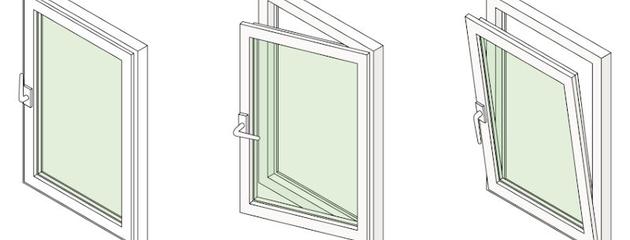
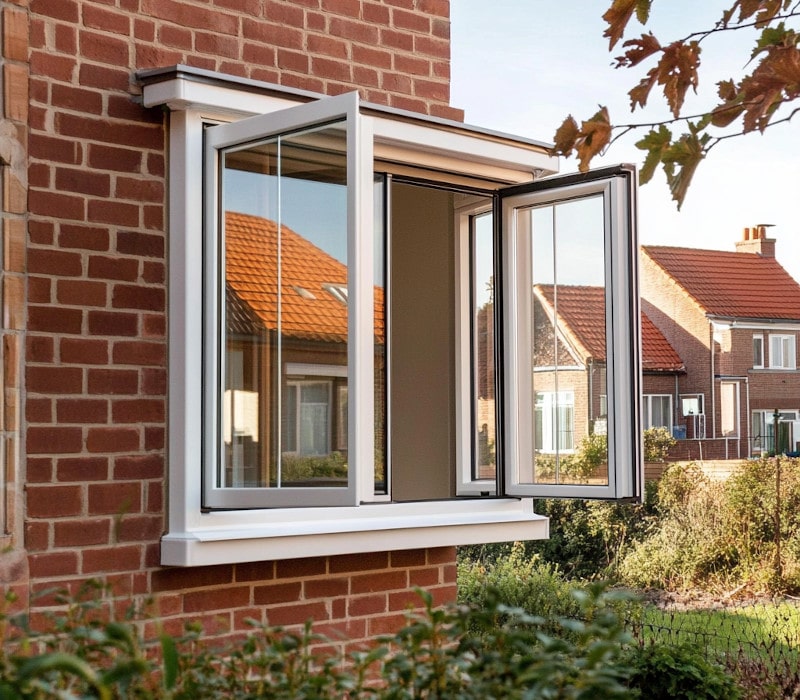
A casement window is hinged on the side and opens outward, like a door. It's operated by a crank handle that pushes the sash open and pulls it back closed. The whole window opens, top to bottom, which is the main reason casement windows are known for strong ventilation.
Common questions
-
Do casement windows open inward?
No. Standard casement windows open outward. If you need an inward-opening window, for example, on a balcony or a tight exterior space, tilt-and-turn windows offer that option. -
Are casement windows the same as crank windows?
Yes, "crank window" is a common name for the same style, referring to the handle that opens it. -
Can a casement window be installed sideways?
If you rotate the design, you get an awning window (hinged at the top) or a hopper window (hinged at the bottom). They're related styles, not the same window installed differently.
Where casement windows fit
- Bedrooms where strong ventilation and egress compliance both matter.
- Kitchens and bathrooms easy to operate from over a sink or vanity.
- Living rooms and main-floor spaces are paired with picture windows to create complementary configurations.
- In hard-to-reach areas, the crank handle is easier than reaching up to lift a hung sash.
Why are casement windows energy-efficient

Casement windows aren't just popular because they ventilate well. They're popular because they seal well. The seal is the key; it's what separates a comfortable, efficient window from a drafty one.
Compression seal technology
When you close a casement window, the sash pulls inward and presses against a seal that runs around the full perimeter of the frame. As the multi-point lock engages, the sash compresses evenly against the seal on all sides. The result is an airtight closure significantly tighter than the weatherstripping used in slider or hung windows, which have to glide along a track and can never seal as completely.
In strong winds, the compression actually increases. The wind pushes the sash harder against the seal, which improves the seal under exactly the conditions that would let drafts through other window styles.
This is why casement windows are consistently rated among the most energy-efficient operable windows in the Canadian market.
What actually drives a casement window's energy performance
A common mistake is to focus only on the frame material. In reality, four things together determine how well a casement window performs:
- The seal compression vs. the weatherstripping, and how completely the lock engages it.
- The glass package: single-, double-, or triple-pane, and which surface treatments are applied.
- The gas fill between panes, argon or krypton, is used to slow heat transfer through the glass cavity.
- The frame material and construction (uPVC, fibreglass, aluminum, or wood) and whether the frame is hollow or reinforced.
This is why a U-factor for a single material can't tell you much on its own. The same uPVC frame can deliver very different U-factor performance depending on the glass package paired with it. Ask for the U-factor of the specific window unit you're considering, not just a generic figure for the frame material.
Glass and gas options
- Double-pane glass is the baseline for Canadian climates. Two panes with an air or argon gas fill between them.
- Triple-pane glass adds a third pane, significantly increasing thermal resistance. Worth considering for cold regions or homes that lose heat noticeably through windows.
- Low-E (low-emissivity) coatings reflect infrared heat back into the room in winter and block UV rays year-round. Standard on modern energy-efficient windows .
- Argon gas fills the space between the panes, reducing heat transfer. Many manufacturers include this by default; some upgrade to krypton for premium glass packages.
- Warm-edge spacers, the strips that separate the panes around the perimeter, reduce heat loss at the edges of the glass unit, which is one of the weakest points in any window.
“The question I get most often is what the difference is between a $700 casement window and a $1,300 one. The honest answer is: most of it is in things you can't see — the seal, the glass package, the spacer, the gas fill, and the frame construction inside the wall. Two casement windows can look identical and perform very differently. The right comparison is on specifications, not just what's visible from the street.”
— Tony Wong, Project Manager, Canadian Choice Windows & Doors
Casement window configurations
Casement windows come in a few standard configurations. Most replacement projects use one or a combination of these:
Single casement
One operable sash, hinged on the side, opening outward. The simplest configuration and the most common for smaller openings in bathrooms, bedrooms, and kitchen side walls.
Double casement
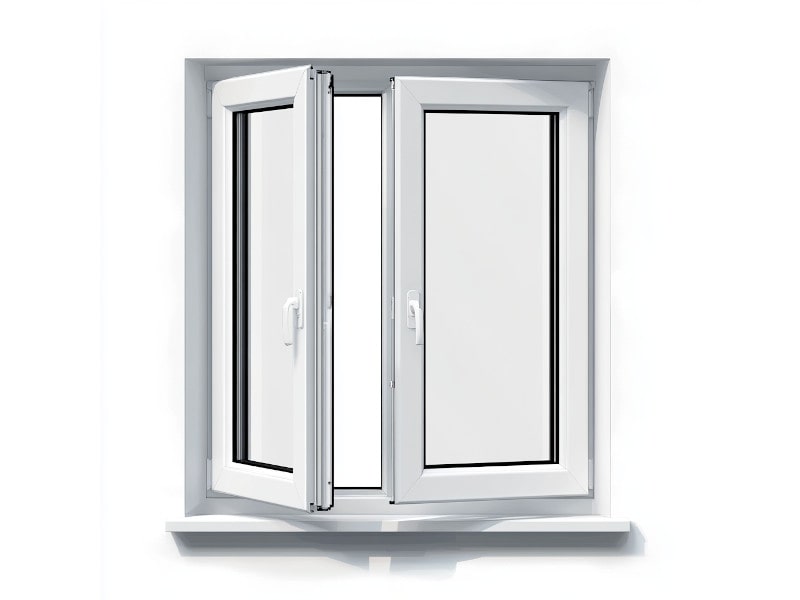
Two sashes side by side, each hinged on its outer edge so they open away from each other (like French windows). Used for wider openings where a single sash would be too tall or too wide to operate easily.
Fixed-casement combination
An operable casement window paired with a fixed (non-opening) window in the same frame. The fixed pane provides natural light and an unobstructed view; the casement provides ventilation. A common configuration for living rooms, where you want a wide light source without operating every panel.
Variations include casement-picture-casement (one fixed pane in the centre flanked by two operable sashes) and similar combinations sized to the opening.
What about fixed casements?
Some windows are built with the casement profile and hardware, but sealed shut; these are sometimes called fixed casements. They look the same as operable casements from the outside, but don't open. Useful when you want a uniform exterior appearance across a row of windows but don't need every unit to function.
Frame materials: what's on the Canadian market
Four frame materials are commonly available for casement windows in Canada. Each has different strengths and trade-offs. CCW manufactures casement windows in uPVC (vinyl). Other materials are available through other Canadian suppliers.
| Material | Strengths | Trade-offs |
|---|---|---|
| uPVC (vinyl) | Affordable. Weather-resistant. Low maintenance. Doesn't rot, rust, or need repainting. Available across most Canadian climates. Canadian Choice Windows & Doors' casement product line is uPVC. | Colour options were once limited, but modern factory finishes and laminated colours have largely closed this gap. |
| Fibreglass | Strong thermal performance. Resists warping and rotting. Holds paint well. | Higher upfront cost. Heavier to handle during installation. Not part of the Canadian Choice Windows & Doors product line. |
| Wood | Classic appearance. Natural insulator. Often chosen for heritage homes. | Requires regular maintenance — staining, sealing, sometimes refinishing. Vulnerable to moisture and Canadian freeze-thaw cycles. Higher cost. |
| Aluminum | Strong, lightweight, low maintenance. Common in commercial buildings. | Poor thermal performance on its own — conducts heat and cold. Mostly used in commercial settings, not common in modern residential casement windows. |
Why Canadian Choice Windows & Doors uses uPVC for casement windows
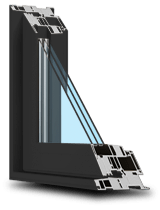
Canadian Choice Windows & Doors casement windows are built with 100% eco-friendly, recyclable uPVC. The frames are triple-sealed and fusion-welded at the corners, with a 4⅝-inch frame depth deeper than the industry standard of 3¼ inches. The added depth gives the frame greater rigidity, helps it seal the rough opening more effectively, and resists sagging or warping in larger window sizes.
Inside the wall, the construction is just as important as what shows on the surface. Reinforced uPVC frames maintain their shape under load, hold the multi-point lock alignment over time, and don't shrink, swell, or rot the way wood can.
What's inside a Canadian Choice Windows & Doors casement window
Here's what's actually in a Canadian Choice Windows & Doors DraftLOCK casement window:
- uPVC (vinyl) frame, 100% eco-friendly and recyclable.
- Triple-sealed welded 4⅝-inch frames and sashes.
- Double or triple-pane glass with Low-E coating.
- Multi-point locking system, plus a security cam to resist forced entry.
- Water-resistant window sill design.
- 180-degree range of motion for ventilation control and easy interior cleaning.
- Up to 30% improvement in home energy rating through air-leak prevention and thermal upgrades.
- ENERGY STAR-compliant configurations available.
- 25-year transferable warranty.
Installation follows Canadian Standards Association (CSA) guidelines. Every install is handled by Canadian Choice Windows & Doors in-house, factory-trained installers no subcontractors.
Casement windows compared to other styles
How a casement window stacks up against the other operable window styles homeowners commonly compare it to:
| Feature | Casement | Slider / single hung | Awning |
|---|---|---|---|
| Seal type | Compression seal (tightest) | Weatherstripping along a track | Compression seal |
| Ventilation | Full opening, top to bottom | Partial — only half the window opens | Partial opens outward from the bottom |
| Operates in the rain | No (rain enters open sash) | No | Yes (top hinge sheds rain) |
| Cleaning | From inside via outward swing | Easy interior, harder exterior | Harder to access the exterior |
| Energy efficiency | Highest among operable styles | Lower (track seal limits) | High (same compression principle) |
| Outdoor clearance needed | Yes — sash swings outward | No | Yes, but smaller swing arc |
Casement windows: what to know before choosing them
Casement windows are an excellent fit for most rooms, but a few practical considerations are worth weighing:
Exterior clearance
Because the sash swings outward, you need space outside for it to open. A casement window installed on a wall facing a narrow walkway, a deck railing, or another building can be problematic. Walk around the exterior of the room you're planning before deciding.
Rain
When a casement window is open, rain can enter. For rooms that need ventilation during light rain, such as kitchens and bathrooms, an awning window is often a better fit, since the top hinge directs rain away from the opening.
Width limitations
Casement sashes work best at taller-than-wide proportions. For very wide openings, a kitchen window above a long counter, for example, a single casement may not be the right answer. Combinations (casement + fixed + casement, or double casements) handle wider openings better than a single oversized sash, which would put strain on the hinges.
Hardware reliance
Casement windows depend on the crank, hinges, and multi-point lock to seal properly. If any of these wear or misalign, the window's seal degrades. Quality hardware matters more on casement windows than on simpler styles. Canadian Choice Windows & Doors casement windows include a security cam alongside the multi-point lock, which keeps the lock alignment consistent over time.
Casement windows and bedroom egress requirements
Any window in a bedroom or sleeping room in Canada must meet egress requirements under the National Building Code. A person must be able to exit through the window in an emergency.
The general requirement is a clear opening of at least 0.35 m² (3.77 sq ft), with no dimension under 380 mm (15 inches). Provincial and municipal codes can vary slightly, so confirm with your installer during the in-home consultation.
Standard casement windows generally meet egress requirements when sized correctly. For tighter openings, an egress hinge allows the sash to open close to 90 degrees so a person can pass through. If you're replacing windows in a bedroom, especially in a finished basement, confirm the egress compliance before signing off on the order.
“Casement windows are usually the first style I suggest for a Canadian home, especially in bedrooms and main living spaces. They seal tightly, they're easy to operate, and they meet egress in most standard openings. The conversation I have with homeowners isn't usually about whether to go with casement — it's about the right glass package and frame depth for their climate. That's where the energy savings actually come from.”
— Helen Sin, Consumer Success Manager, Canadian Choice Windows & Doors
Casement window maintenance
Casement windows are low-maintenance, but they're not no-maintenance. A few small habits keep them working well for decades:
Routine care
- Clean the glass and frame regularly. uPVC frames respond well to a basic soap-and-water clean, no harsh chemicals needed.
- Wipe down the compression seal once or twice a year. Built-up grit or debris in the seal channel can affect how tightly the sash compresses against the frame.
- Apply a light lubricant to the crank mechanism and hinges once a year. Standard silicone-based lubricant works well and avoids the heavy oils that attract dirt.
Annual check
- Open and close each window fully a few times. The sash should glide smoothly. If it sticks, hesitates, or the crank feels stiffer than usual, the hinges or the multi-point lock may need attention.
- Check for visible damage to the seal, cracks, gaps, and sections that look compressed flat. Damaged seals are the most common cause of drafts and should be replaced.
- Inspect the exterior frame for any cracking, fading, or pulling away from the wall. Caulking around the exterior may need to be topped up every several years, depending on exposure.
When to call a professional
- The window won't close completely, or the lock won't fully engage.
- Drafts are noticeable even with the window locked.
- There's condensation between the glass panes (not just on the surface). This indicates a failed seal in the insulated glass unit, and the glass package likely needs to be replaced.
- Visible damage to the frame, sash, or hardware.
Canadian Choice Windows & Doors' 25-year transferable warranty covers manufacturer defects and certain hardware failures. After-sales service is part of the install; if something stops working as it should, the service team can come back and address it.
Why Canadian homeowners choose Canadian Choice Windows & Doors for casement windows
Canadian Choice Windows & Doors has been serving Canadian homes for over 40 years. Every window is manufactured at our Canadian facility, custom-built for your opening, and installed by our own in-house teams.
- Recommended by Bryan Baeumler, HGTV host and Canada's recognized construction expert.
- Over 3,100 positive reviews on HomeStars.
- More than 1 million windows and doors have been installed across Canada.
- 25-year transferable warranty on every casement window.
- uPVC frames built to ASTM and NFRC standards, with 4⅝-inch frame depth and triple-sealed welded corners.
- DraftLOCK sealing technology engineered for Canadian climates.
- Multiple series available — DraftLOCK, DraftLOCK Slim Contour , and DraftLOCK Plus Slim Contour (triple-glazed) — depending on the energy performance and aesthetic you need.
- Wide range of colours, grille options, glass packages, and configurations.
Frequently asked questions
What is a casement window?
A casement window is hinged on the side and opens outward, operated by a crank handle. Unlike sliding or hung windows, the whole sash opens, providing better ventilation and a clearer view. Casement windows are also among the most energy-efficient operable window styles because of how their seals work.
Are casement windows more energy-efficient than other styles?
They tend to be, yes, but the energy performance depends on the whole assembly, not just the style. Casement windows use a compression seal that tightens as the sash closes. This generally seals more completely than the weatherstripping used on sliders and hung windows. Pair a casement window with double or triple-pane glass, a Low-E coating, and an argon gas fill, and you get one of the most energy-efficient operable windows available.
Can casement windows open inward?
No. Standard casement windows open outward. If you need an inward-opening operable window, for example, in a condo where furniture sits close to the wall, tilt-and-turn windows offer that option.
Do casement windows meet bedroom egress requirements?
In most cases, yes. The National Building Code requires a clear opening of at least 0.35 m² (3.77 sq ft), with no dimension under 380 mm (15 inches). Standard casement windows meet this when sized correctly. For tighter openings, an egress hinge allows the sash to open close to 90 degrees. Confirm with your installer during the in-home consultation, since provincial and municipal codes can vary.
How long do casement windows last?
A well-installed casement window with a uPVC frame typically lasts 30 to 40 years. Lifespan depends on three things: frame and hardware quality, installation precision, and ongoing maintenance, particularly keeping the compression seal clean and the crank mechanism lubricated.
What's the best frame material for a casement window in Canada?
For most Canadian homes, uPVC (vinyl) is the practical first choice, affordable, low-maintenance, weather-resistant, and well-suited to freeze-thaw cycles. Fibreglass offers strong thermal performance but at a higher cost. Wood looks beautiful and insulates well, but needs ongoing maintenance and isn't ideal in damp or extreme climates. Canadian Choice Windows & Doors manufactures casement windows in uPVC.
Can casement windows be combined with other window styles?
Yes. Casement-picture combinations (an operable casement next to a fixed picture window) are common in living rooms and on main floors. Double casements work for wider openings. Casement-fixed-casement configurations balance side ventilation with a large light source in the centre.
What's the difference between a casement and an awning window?
Both use a crank handle and a compression seal. The difference is the hinge: a casement is hinged on the side and opens outward like a door, while an awning is hinged at the top and opens outward from the bottom. Awning windows can stay open in light rain because the open sash sheds water away from the opening; casement windows can't.

1000’s of Colours & Textured Finishes
Transform your home from ordinary to extraordinary with our new coloured and non-glare textured finishes. Available in a wide array of colours as well as custom matched colours for your very own personalized design.
Our Most Popular Replacement Window Colours: